Why Is RAM So Expensive in 2026? The Global Memory Shortage Explained
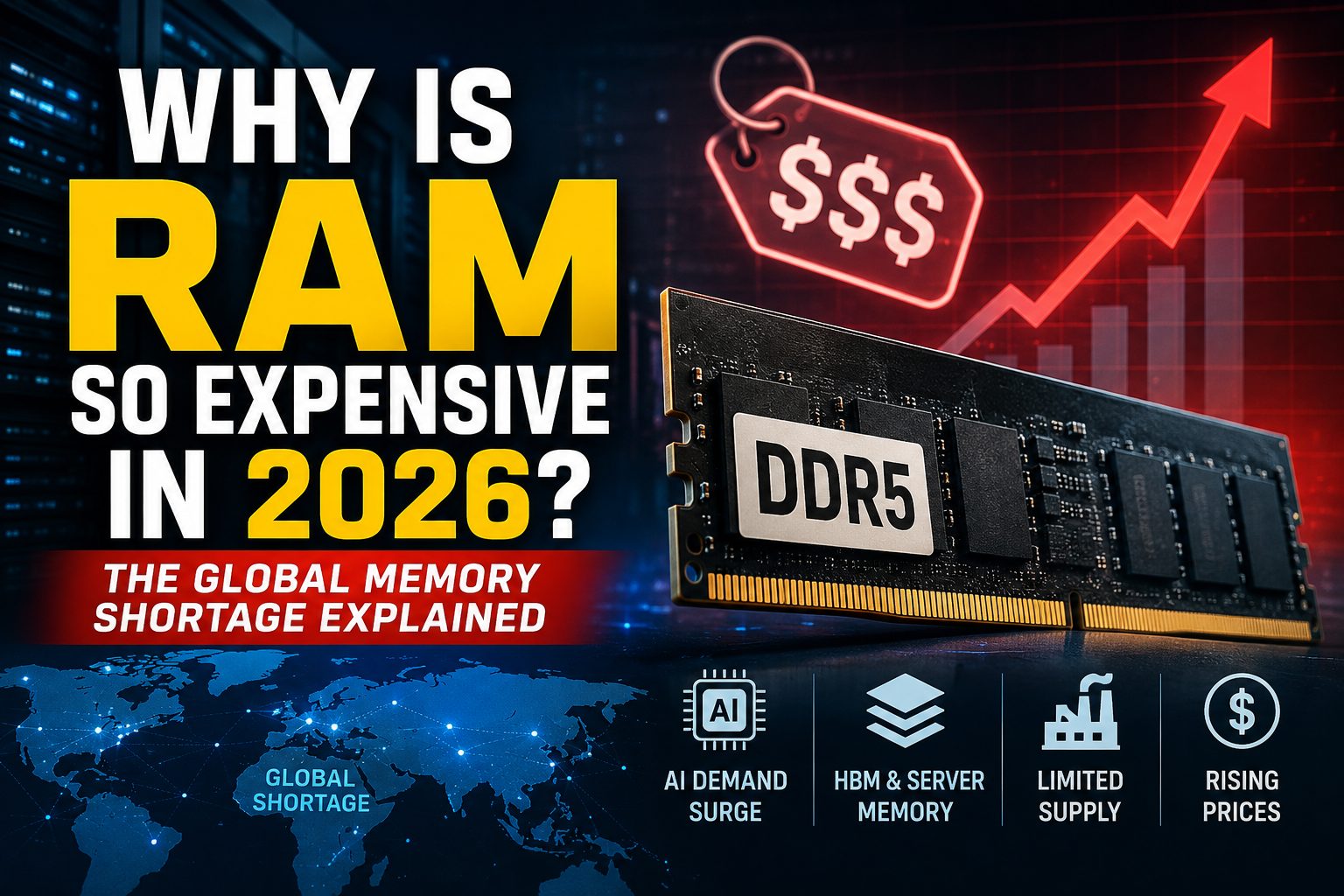
Why is RAM so expensive in 2026? If you have checked RAM prices recently, you may have noticed something unusual: memory is becoming much more expensive, and some DDR5 kits are difficult to find at reasonable prices. The reasons go far beyond gamers buying more memory. AI data centers, HBM demand, server DRAM, and limited manufacturing capacity are putting pressure on the global memory market.
The answer goes far beyond gamers buying more memory. AI data centers, HBM demand, server DRAM, and limited manufacturing capacity are putting pressure on the entire memory supply chain. Current industry data shows that this is a real market shift, although the impact varies between DDR4, DDR5, server memory and mobile DRAM.
Why Is RAM So Expensive Right Now?
The basic answer is supply and demand, but the current RAM shortage in 2026 is more complicated than that. Memory manufacturers have limited production capacity, while demand from AI infrastructure and servers is growing quickly. At the same time, consumer demand is weakening because higher prices are making PCs and smartphones less affordable.
According to TrendForce’s latest DRAM market analysis, conventional DRAM contract prices are forecast to rise 13–18% quarter over quarter in Q3 2026. TrendForce also says the DRAM market remains extremely tight.
The main reasons behind rising RAM prices
- AI data-center demand is increasing.
- HBM memory is consuming valuable DRAM manufacturing capacity.
- Server DDR5 demand remains strong.
- Manufacturers are prioritizing higher-value memory products.
- New semiconductor capacity takes years to build.
- Consumer DDR4 and DDR5 supply is being squeezed.
So, if you’re asking whether retailers alone are responsible for the price increases, the answer is no.
The pressure starts much earlier in the semiconductor supply chain.
How Is AI Causing the Global RAM Shortage?
This is probably the most important part of the story.
When people talk about the AI boom, they usually focus on GPUs. But powerful AI systems also require huge amounts of high-bandwidth memory and server DRAM to move data between processors and memory.
That’s why AI companies and cloud providers are buying enormous quantities of specialized memory.
SK hynix’s 2026 market outlook describes the current situation as an HBM-led memory supercycle, with AI infrastructure driving strong demand for HBM, server DRAM and other memory products.
And here’s the interesting part:
AI doesn’t just increase total memory demand.
It also changes which types of memory manufacturers want to produce.
What Is HBM and Why Does It Matter?
HBM, or High Bandwidth Memory, is a specialized type of DRAM designed to provide extremely high memory bandwidth. It is particularly important for AI accelerators because AI workloads constantly move enormous amounts of data.
That creates a problem for the traditional memory market.
Manufacturers have finite production resources. When more capacity is allocated to HBM and high-end server memory, less capacity may be available for some conventional DRAM products.
TrendForce says major DRAM manufacturers are prioritizing HBM and server production, which is squeezing consumer DRAM supply.
Think of it this way:
AI isn’t necessarily taking the exact RAM stick from your PC. It’s competing for the manufacturing resources used to make different kinds of memory.
That distinction is important.
Why Are DDR5 Prices Rising?
For ordinary PC users, this is the part that matters most.
If you’re planning a PC upgrade, check our guide to the best DDR5 RAM for gaming in 2026 to understand which capacity and speed makes sense for your system.
You don’t need an AI data center to feel the effects of the DDR5 shortage. Consumer memory is connected to the same broader DRAM supply chain.
TrendForce reports that top DRAM manufacturers are prioritizing server production, while consumer DRAM supply is being squeezed. It expects the structural shortage to remain difficult to resolve in the near term.
Retail prices have also become extreme in some markets. Tom’s Hardware recently reported a 32GB DDR5-6000 kit rising from approximately $72 to $392 in one tracked example. It also reported that automated bots accounted for 91% of interactions on one retailer’s DDR5 listings.
That doesn’t mean every 32GB kit everywhere costs $392.
RAM prices vary by country, brand, speed, capacity and retailer.
But it shows how unusual the current DDR5 RAM price increase has become.
Why Can't Samsung, SK hynix and Micron Just Make More RAM?
You might be thinking:
“If RAM is so expensive, why don’t manufacturers simply produce more?”
That’s a fair question.
Unfortunately, semiconductor production doesn’t work like opening another production line in a normal factory.
Manufacturers need:
- Advanced fabrication equipment
- Cleanrooms
- Semiconductor fabs
- Packaging capacity
- Skilled workers
- New manufacturing processes
- Years of investment
And even after a company announces a new factory, the additional memory doesn’t appear immediately.
SK hynix, for example, has announced major investments in new DRAM and NAND facilities, but new production capacity takes years to come online.
That’s why the global memory shortage cannot be solved overnight.
Samsung vs SK hynix vs Micron
Three companies are particularly important when discussing the DRAM market: Samsung Electronics, SK hynix and Micron.
Samsung remains one of the world’s major memory manufacturers and is heavily involved in HBM and server memory.
SK hynix has become especially important in the HBM market as AI infrastructure expands. Its 2026 outlook highlights strong growth in HBM3E and the transition toward HBM4.
Micron is also investing heavily in AI-related memory production and has highlighted the increasing importance of HBM and data-center memory.
Together, their production decisions have a major influence on the global DRAM supply.
Will RAM Shortages Make Laptops and Phones More Expensive?
Potentially, yes.
RAM is only one part of a laptop or smartphone, so it would be wrong to claim that every device will suddenly become dramatically more expensive because of memory.
However, higher DRAM prices increase component costs for manufacturers.
TrendForce says smartphone manufacturers are expected to raise retail prices in Q3 2026 to offset persistently high LPDRAM costs, while weaker consumer demand is also making manufacturers more cautious.
This could lead manufacturers to:
- Increase device prices
- Offer smaller memory configurations
- Reduce discounts
- Delay upgrades
- Absorb some costs through lower margins
So the RAM shortage can eventually reach consumers who aren’t buying RAM separately.
When Will RAM Prices Go Down?
This is the million-dollar question.
Unfortunately, there isn’t a reliable date when someone can say, “RAM will become cheap again on this exact day.”
Current evidence suggests the market will remain tight in the near term.
TrendForce’s July 2026 research says AI-server demand and capacity reallocation are keeping DRAM supply constrained, while new production capacity is not arriving quickly enough to completely close the gap.
However, memory markets are cyclical.
If AI infrastructure spending slows, manufacturers add enough capacity, or production is shifted back toward conventional DRAM, prices could eventually fall.
In other words, high RAM prices are not guaranteed forever.
Should You Buy RAM Now or Wait?
If your PC genuinely needs more memory, I wouldn’t wait indefinitely hoping prices suddenly return to their old levels.
Before buying, however, check:
- Whether your system uses DDR4 or DDR5.
- The maximum RAM capacity your motherboard supports.
- Your current RAM configuration.
- Prices from multiple retailers.
- Whether you actually need the upgrade.
If you already have enough RAM for your workload, panic-buying isn’t necessary.
But if you’re constantly hitting your memory limit while gaming, editing videos, programming or running multiple applications, upgrading can still make sense.
Frequently Asked Questions
Why is RAM so expensive in 2026?
The biggest factors are AI memory demand, HBM production, server DRAM demand, limited manufacturing capacity and tighter consumer DRAM supply.
Is AI causing the RAM shortage?
AI is a major contributor, particularly because data centers require large quantities of HBM and server DRAM. Manufacturers are also reallocating capacity toward these higher-demand products.
Will DDR5 prices go down?
They eventually could, but current market research points toward continued tight supply in the near term. The timing depends on new capacity, AI demand and manufacturers’ production decisions.
Is there really a global RAM shortage?
There is a significant supply-demand imbalance in several memory categories, but availability varies by product and region. It is more accurate to describe the market as structurally tight rather than claiming every RAM product is unavailable.
Final Verdict
So, why is RAM so expensive in 2026?
The answer is bigger than your gaming PC.
The rapid expansion of AI data centers has created enormous demand for HBM and server memory. At the same time, manufacturers have limited production capacity and are prioritizing some higher-value memory products, putting pressure on conventional DDR4 and DDR5 RAM.
The good news is that manufacturers are investing in additional capacity.
The bad news is that semiconductor manufacturing takes time.
For you as a buyer, the smartest approach is simple: don’t panic-buy RAM, but don’t assume prices will immediately return to their old levels either.
The RAM shortage is really a story about how the AI boom is changing the hardware industry—and your next PC upgrade may be one of the places where you notice it first.