Why Are SSD Prices Rising in 2026? How AI Data Centers Are Changing the Storage Market
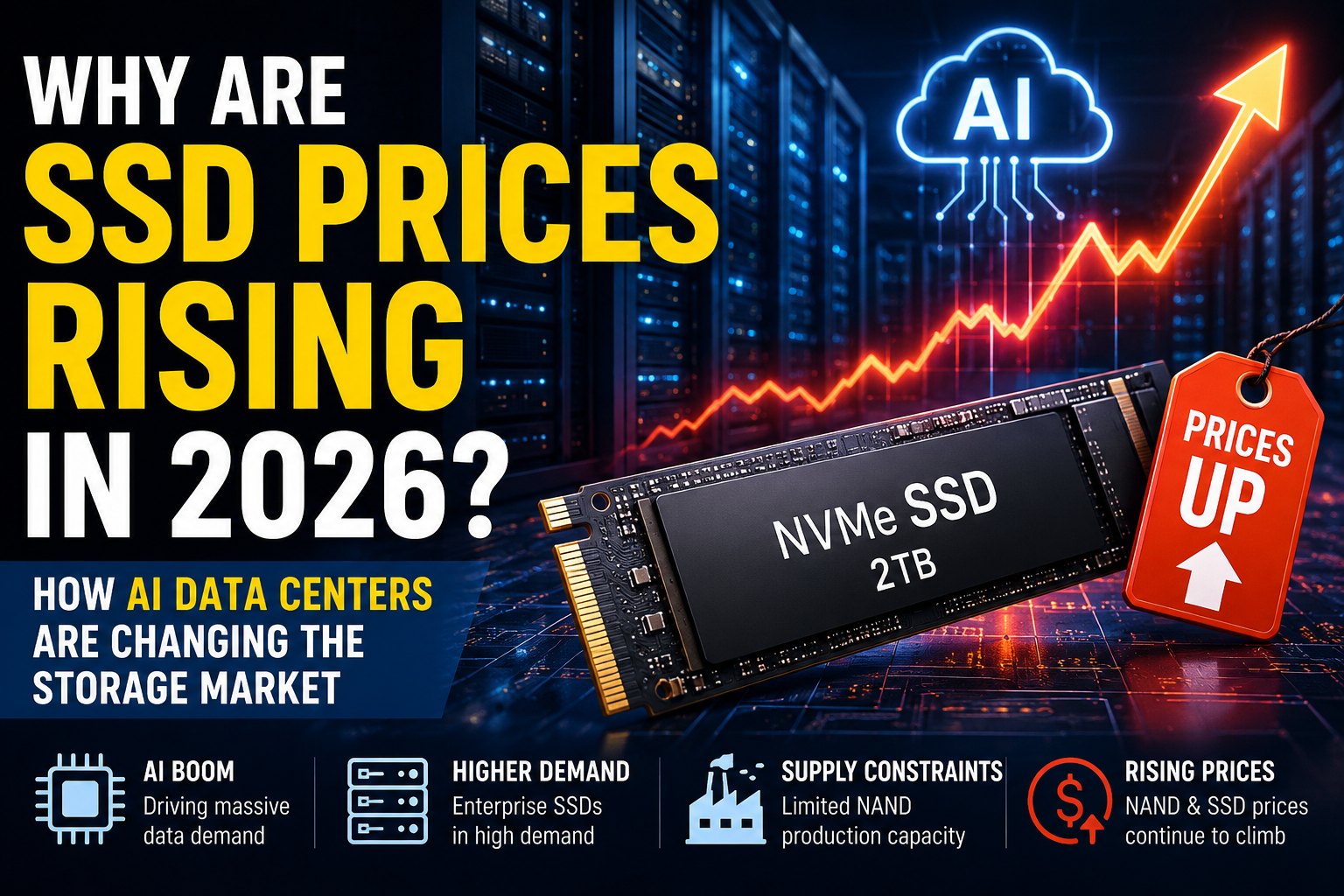
SSD prices in 2026 are rising because AI data centers are increasing demand for enterprise storage and NAND flash memory, while manufacturers have limited capacity and are prioritizing higher-value server products. TrendForce forecast NAND Flash contract prices to rise 10-15% quarter over quarter in Q3 2026, although weaker consumer demand is limiting how fast prices can climb.
If you’ve checked the price of an SSD recently and thought, “Wait… weren’t these supposed to be getting cheaper?”
You’re not imagining it.
The storage market has changed.
For years, SSDs followed a familiar pattern: better technology, more production, more capacity, and eventually lower prices. In 2026, however, the explosion in AI data center storage demand has changed that equation.
And here’s the surprising part.
AI isn’t simply buying up the same 1TB and 2TB SSDs that you put in your gaming PC. Instead, AI infrastructure is putting pressure on the broader NAND flash supply chain, while manufacturers increasingly focus on enterprise and data-center customers.
So, why are SSD prices rising in 2026, and should you buy an SSD now or wait?
Let’s break it down.
| SSD | Type | 1TB | 2TB |
|---|---|---|---|
| Kingston NV3 | PCIe 4.0 budget | from €140* | from €250 |
| Lexar NM790 | PCIe 4.0 value | from €179 | from €303 |
| WD_BLACK SN850X | PCIe 4.0 gaming | from €221* | from €340 |
| Samsung 990 PRO | PCIe 4.0 premium | from €284* | from €356 |
| T700 | PCIe 5.0 high-end | from €202 | from €702 |
Newegg says 2TB NVMe drives that once hovered near $120 now start above $200. You can use that, with a link to Newegg’s article, to show how much prices have risen.
What Is Happening to SSD Prices in 2026?
The first thing to understand is that there isn’t one single price trend for every SSD. Consumer drives, enterprise SSDs, NAND wafers, and specialized storage products can experience very different market conditions. Nevertheless, the underlying NAND market is facing significant demand from servers and AI infrastructure. TrendForce’s latest Q3 2026 forecast puts NAND Flash contract-price growth at 10–15% QoQ, while noting that PC and smartphone customers are increasingly hitting affordability limits.
That creates a fascinating split.
AI demand is still strong. Consumer demand is becoming cautious.
So the market isn’t simply “everything is getting more expensive.”
Instead, higher-value enterprise demand is helping support NAND prices while consumers are becoming less willing—or less able—to absorb additional increases.
The key numbers to know
| Market factor | Current 2026 situation |
|---|---|
| Q3 2026 NAND Flash contract-price forecast | +10–15% QoQ |
| Q4 2026 conventional DRAM forecast | +13–18% QoQ |
| Example Kioxia enterprise SSD | 245TB |
| Kioxia + Sandisk planned Japan investment | More than $31 billion through 2032 |
| Expected NAND supply improvement | Potentially from H2 2027 |
The important takeaway is simple:
The SSD market is being affected by a much larger memory-industry shift.
Why Does AI Need So Much Storage?
When people talk about AI infrastructure, GPUs usually steal the spotlight.
That’s understandable.
But an AI data center isn’t just a room full of GPUs. Behind those accelerators is an enormous storage infrastructure responsible for keeping datasets, model files, checkpoints, logs, application data, and other information available.
As AI models become larger and AI applications reach more users, the amount of information that needs to be stored and processed also grows.
That’s why AI storage demand is becoming increasingly important to the NAND market.
Here's how the storage cycle works
Step 1: AI systems consume massive datasets.
Training data has to be stored somewhere before models can process it.
Step 2: Models repeatedly access data.
Depending on the workload, fast storage can become an important part of the infrastructure.
Step 3: Training generates additional information.
Checkpoints, logs, intermediate files, and model versions all require storage.
Step 4: Inference creates another stream of data.
Once an AI model is deployed, millions of interactions can generate additional information.
Step 5: Data centers scale.
More users and more AI workloads mean more servers, more storage, and more infrastructure.
The scale is already impressive.
Kioxia has developed a 245TB enterprise SSD aimed at demanding data-center workloads. That gives you an idea of just how different enterprise storage has become compared with the 1TB or 2TB drives commonly found in consumer PCs.
Is AI Directly Making Your SSD More Expensive?
Not exactly.
This is where a lot of explanations get it wrong.
AI companies aren’t simply purchasing every consumer SSD available and putting it into their servers.
The connection is the NAND flash memory underneath the storage market.
Consumer and enterprise SSDs are different products. Enterprise drives are built around demanding workloads, endurance, reliability, capacity, and continuous operation.
But both markets depend on NAND manufacturing.
When demand for enterprise storage rises sharply, NAND manufacturers have a strong incentive to direct available capacity toward those higher-value products.
TrendForce says AI and data-center demand is supporting enterprise SSD shipments while suppliers are developing storage products specifically for AI workloads.
The chain looks like this:
AI boom → more data centers → greater enterprise SSD demand → more NAND demand → tighter supply → higher NAND costs → pressure across the SSD market
That’s the real story.
Why Are Memory Manufacturers Prioritizing AI?
Now we get to the business side.
Semiconductor companies don’t have unlimited production capacity. Building new fabs and expanding memory manufacturing requires huge investments, specialized equipment, engineering resources, and years of preparation.
So manufacturers have to decide where their limited capacity generates the most value.
Right now, AI infrastructure is one of the biggest sources of demand in the semiconductor industry.
Enterprise customers also purchase storage at enormous scale.
That changes manufacturers’ priorities.
Micron's Crucial decision is a major example
In December 2025, Micron announced that it would exit its Crucial consumer business. The company explicitly said that AI-driven data-center growth had caused a surge in demand for memory and storage and that it wanted to improve supply and support for larger strategic customers in faster-growing markets.
This doesn’t mean Micron stopped manufacturing memory.
It means the company decided to move away from selling consumer products under the Crucial brand and focus its resources on other parts of the market.
That’s a significant signal.
The AI boom is influencing not only what data centers buy, but also how major memory manufacturers allocate resources.
Why Are Enterprise SSDs Under So Much Pressure?
The biggest price pressure isn’t necessarily on the average consumer SSD.
It’s particularly strong in enterprise SSDs and data-center storage.
These products are designed for environments where storage may operate continuously under heavy workloads.
Enterprise SSDs can offer:
- Very high capacities
- High endurance
- Specialized firmware
- Advanced error correction
- Sustained performance
- 24/7 operation
- Data-center reliability
For a cloud company running AI infrastructure, spending heavily on storage can make sense.
For a gamer who simply wants another 2TB for their Steam library?
You probably don’t need enterprise hardware.
That’s why you should avoid looking at extreme enterprise SSD prices and assuming your next consumer SSD will cost the same.
Why Can't Companies Just Make More NAND?
At first glance, the solution seems obvious.
Demand increases.
Manufacturers produce more NAND.
Prices fall.
Problem solved.
Unfortunately, semiconductor manufacturing doesn’t work that quickly.
A new memory facility requires enormous capital investment and years of construction, equipment installation, qualification, and production ramp-up.
And there is another problem: manufacturers have to decide how aggressively to add capacity.
If they overbuild, NAND prices can collapse.
If they underbuild, shortages can continue.
That’s a difficult balancing act.
TrendForce reported in May 2026 that major NAND suppliers were expected to add virtually no new production capacity during 2026, with AI-related demand contributing to continued supply pressure.
So even if manufacturers know demand is rising, they can’t simply switch on a giant new NAND factory tomorrow.
Will SSD Prices Go Down in 2027?
This is probably the question you’re really asking.
The answer is: possibly, but don’t expect a guaranteed price crash.
TrendForce’s research indicates that NAND supply conditions could become more favorable as new capacity and manufacturing improvements take effect, particularly later in 2027. At the same time, consumer demand remains a limiting factor because high prices can push buyers to delay upgrades.
That means several scenarios are possible.
Scenario 1: AI demand stays extremely strong
If AI infrastructure continues expanding rapidly, enterprise storage demand could remain strong.
Result: NAND prices could stay elevated.
Scenario 2: Supply catches up
If new capacity ramps successfully while consumer demand stays weak, the supply-demand balance could improve.
Result: SSD prices could stabilize or decline.
Scenario 3: AI spending slows
If data-center investment slows significantly, NAND demand could weaken.
Result: manufacturers could face excess supply, potentially putting downward pressure on prices.
The market is therefore much more complicated than simply asking whether SSD prices “will go up.”
What Are NAND Flash and SSDs?
If you’re new to PC hardware, don’t worry. The terminology sounds complicated, but the basic idea is simple.
NAND flash is the non-volatile memory technology used to store data inside many SSDs.
An SSD, or solid-state drive, is the finished storage device that connects to your computer.
Think of it this way:
NAND = storage memory
SSD = complete storage device
An SSD also contains components such as a controller, firmware, and sometimes DRAM cache.
That’s why a change in NAND pricing doesn’t automatically translate into the exact same percentage change at the retail level.
Retail prices are influenced by manufacturing costs, controllers, packaging, distribution, retailer margins, promotions, exchange rates, and competition.
Should You Buy an SSD in 2026?
If you need more storage, the current market is worth paying attention to, because AI infrastructure is putting pressure on NAND supply.
If you actually need additional storage, I wouldn’t wait forever.
That’s especially true if your current drive is almost full.
You don’t need to predict the exact bottom of the NAND market to make a good purchase.
Instead, follow a simple process.
Step 1: Check your current storage
If your drive has very little free space, an upgrade can immediately improve your situation.
Don’t make your computer miserable just because you’re waiting for a theoretical future discount.
Step 2: Decide your capacity
For a basic computer, 1TB SSD storage can be enough.
For gaming, content creation, and heavier everyday use, 2TB SSD storage is often a much more comfortable choice.
If you work with large video files or datasets, you may need even more.
Step 3: Choose the right interface
For most modern PCs, an NVMe SSD is the obvious option when the motherboard or laptop supports it.
A good PCIe 4.0 SSD already delivers excellent real-world performance for gaming and everyday computing.
You don’t automatically need a premium PCIe 5.0 model.
Step 4: Compare the important specifications
Don’t choose a drive based only on its advertised sequential read speed.
Look at:
- NAND type
- Controller
- Endurance/TBW
- Warranty
- Sustained performance
- Independent reviews
- Thermal behavior
- Your system’s compatibility
Step 5: Buy when the price makes sense
You don’t need to catch the absolute lowest price in history.
If a reputable 2TB SSD reaches a price you’re comfortable with and you actually need the storage, buying it is reasonable.
1TB vs 2TB SSD: Which One Should You Get?
For office work, browsing, schoolwork, and basic applications, 1TB can still be perfectly adequate.
But for a gaming PC in 2026, I’d lean toward 2TB if your budget allows.
Modern games can be huge.
Add Windows, applications, screenshots, videos, downloads, and personal files, and a 1TB drive can become surprisingly cramped.
A 2TB drive also means you won’t have to upgrade again as quickly.
And if SSD prices are rising, buying the capacity you genuinely need during a good sale can be more sensible than buying a smaller drive now and another one later.
What Is the Storage Industry Doing About the Problem?
The industry isn’t sitting around waiting for prices to solve themselves.
Manufacturers are investing billions in additional production and developing denser NAND technologies.
One of the biggest recent announcements came from Kioxia and Sandisk.
The companies announced plans to invest more than $31 billion in Japan through 2032 to advance semiconductor technology and expand memory-chip production, with the investment driven in part by growing AI-related demand.
That matters because additional production capacity can eventually help the supply side of the market.
At the same time, manufacturers are developing increasingly dense NAND technologies to store more information in smaller physical footprints.
So the long-term solution isn’t simply “make more SSDs.”
It’s:
more NAND capacity + denser NAND + better manufacturing + smarter storage architectures
The Bigger Picture: AI Is Changing the Economics of Storage
The most important lesson here isn’t actually the price of a 2TB SSD.
It’s that AI is changing how the entire storage industry thinks about capacity.
For years, consumer storage followed a simple trend:
More capacity → lower cost per GB → even more capacity
AI is disrupting that pattern by creating huge demand for enterprise storage and high-capacity flash.
And the scale is still growing.
That doesn’t mean your gaming PC needs one of these technologies.
It means storage itself is becoming a strategic part of AI infrastructure.
Frequently Asked Questions About SSD Prices in 2026
Why are SSD prices rising in 2026?
The main factors are strong AI and data-center demand, increased enterprise SSD requirements, NAND supply constraints, and manufacturers prioritizing higher-value server products. TrendForce currently forecasts NAND Flash contract prices to rise 10–15% QoQ in Q3 2026.
Is AI directly causing consumer SSD prices to rise?
Not directly. AI data centers primarily create additional demand for enterprise storage and NAND flash. That demand can tighten the broader supply chain and contribute to higher component costs.
Will SSD prices go down in 2027?
They could. Industry forecasts indicate NAND supply conditions may improve as additional production and manufacturing improvements take effect, particularly later in 2027. However, the final retail price will depend on AI demand, consumer demand, supply growth, and competition.
Should I buy an SSD now or wait?
If you need more storage now, buying a reputable SSD during a good sale is reasonable. If your existing drive has plenty of free space, you can wait and monitor prices.
Is a 2TB SSD worth buying in 2026?
For many gamers and power users, yes. A 2TB SSD provides substantially more room for modern games, applications, media, and personal files and can reduce the need for another upgrade soon.
Do I need a PCIe 5.0 SSD?
Not necessarily. A quality PCIe 4.0 NVMe SSD is already fast enough for most gaming and everyday workloads. PCIe 5.0 becomes more attractive when your workload can actually benefit from its higher throughput.
Final Verdict: Should You Buy an SSD?
So, why are SSD prices rising in 2026?
The answer isn’t simply “because AI is buying SSDs.”
The bigger story is the combination of AI data-center expansion, enterprise SSD demand, NAND flash demand, limited production capacity, and manufacturers shifting resources toward higher-value memory products.
At the same time, consumer buyers are becoming more price-sensitive, which is preventing the market from moving upward without resistance.
The long-term outlook is therefore mixed.
New investments and manufacturing advances should eventually improve supply. Kioxia and Sandisk alone are planning more than $31 billion of investment in Japan through 2032.
But AI infrastructure is expanding quickly, and that demand isn’t disappearing overnight.
So here’s my advice:
If you need an SSD, don’t panic-buy—but don’t wait forever either.
Choose a reputable NVMe SSD, get enough capacity for your actual needs, compare specifications carefully, and buy when you find a strong deal.
For many gamers and everyday PC users, 2TB is the sweet spot.
Because the biggest lesson from the 2026 storage market is surprisingly simple:
AI isn’t just changing how computers think. It’s changing how much data the world needs to store—and that is reshaping the economics of SSDs.