Tesla Roadster 2026: Shocking Thruster Tech, Speed and Release Date
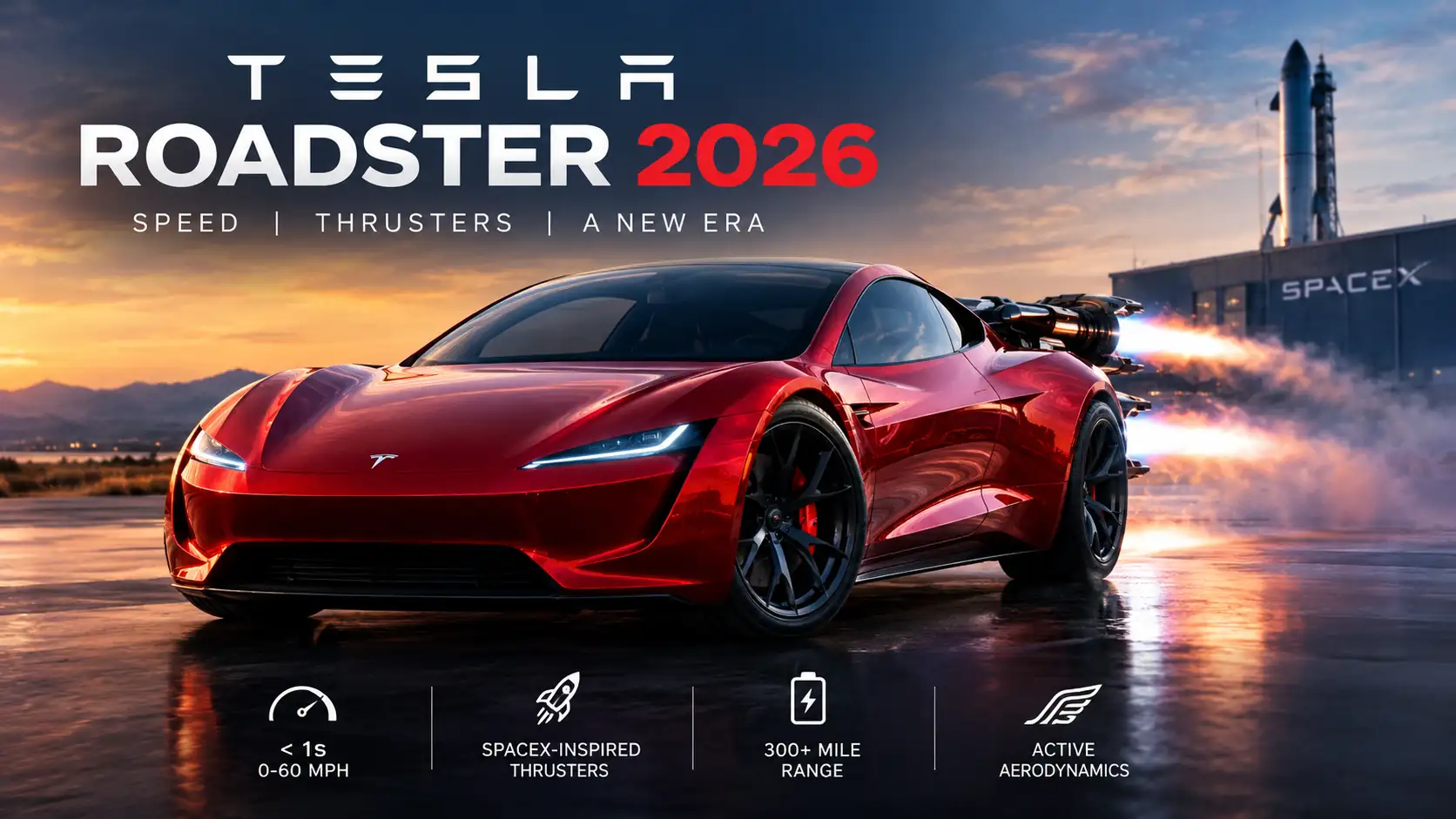
The Tesla Roadster 2026 has finally been revealed, bringing electric supercar performance and SpaceX-inspired thruster technology into the spotlight. Unveiled on October 15, 2026, the redesigned sports car demonstrated dramatic acceleration, an unusual suction system and brief airborne maneuvers. However, its production timeline, final price and real-world capabilities still need careful examination.
Tesla is targeting production in 2028, almost nine years after first revealing its second-generation Roadster. Here is what you need to know about its specifications, technology, reservation costs and potential limitations.
What Is the Tesla Roadster 2026?
The Tesla Roadster 2026 is a next-generation, all-electric sports car designed to demonstrate how far electric vehicle engineering can go. Unlike conventional electric cars, the new Roadster combines an electric powertrain with optional cold-gas thrusters developed using technology associated with SpaceX.
Tesla presented the redesigned vehicle at a SpaceX testing facility in McGregor, Texas. During the demonstration, the prototype drove up a steep ramp, traveled upside down using a suction system, and performed an airborne maneuver before landing.
According to Reuters’ report on the Tesla Roadster reveal, the company is targeting production in 2028. However, a reveal does not mean the production model is ready for customer delivery.
The new Roadster also represents an important moment for Tesla. The company first announced its second-generation sports car in 2017, but repeated delays pushed its expected arrival back by several years.
Tesla Roadster 2026 Specifications: Speed, Range and Performance
Tesla has shared ambitious performance claims, although several important production specifications remain undisclosed. The following table summarizes the reported information available after the October 2026 reveal.
| Specification | Reported details |
|---|---|
| Vehicle type | All-electric sports car |
| Claimed acceleration | 0–60 mph in under one second with thrusters |
| Demonstration timing | Approximately 0.8 seconds claimed |
| Claimed top speed | More than 230 mph |
| Reported range | More than 300 miles per charge |
| Seating | Two seats in Performance and Thrust; one in Rocket |
| Production target | 2028 |
| Final purchase price | Not announced |
Sources: Reuters and Car and Driver’s Roadster first look.
These figures should be treated as reported claims, not independently verified production-car results.
Tesla Roadster 2026 Acceleration and Top Speed
The most attention-grabbing claim is the Roadster’s ability to accelerate from zero to 60 mph in less than one second when equipped with the optional thruster system.
For context, 60 mph is approximately 97 km/h. Achieving that speed in under a second would place the vehicle in an extraordinary performance category, but the precise timing method matters.
Reuters Connect’s demonstration coverage notes that the reported 0–60 mph timing began after the vehicle had already moved its first foot. That distinction matters when comparing the figure with independently measured acceleration times from other vehicles.
Tesla has also claimed a top speed exceeding 230 mph, or approximately 370 km/h. Independent testing will be necessary to establish the production car’s actual performance.
Tesla Roadster 2026 Battery Range and Charging
The reported range is more than 300 miles on a single charge. This is a significant detail because performance-focused electric vehicles must balance battery capacity, power delivery, aerodynamics and energy consumption.
However, Tesla has not published a complete set of production specifications covering battery capacity, charging time, charging power, battery chemistry or real-world highway range.
The earlier second-generation Roadster concept was promoted with a much higher range claim of 620 miles. The latest reported figure is substantially lower, so readers should not assume that the original specification still applies.
For buyers, the most useful future information will be independently measured range, charging performance, battery degradation and cold-weather efficiency.
How Tesla Roadster 2026 Thruster Technology Works
The biggest difference between the new Roadster and conventional electric sports cars is its optional SpaceX-inspired propulsion technology.
Rather than relying entirely on electric motors and tires for acceleration and maneuvering, the more extreme configurations add cold-gas thrusters. Tesla demonstrated this technology during the launch event, but the long-term practicality of the system remains uncertain.
Tesla Roadster 2026 Cold-Gas Thrusters Explained
Cold-gas thrusters work by releasing pressurized gas through specially designed nozzles. The escaping gas generates thrust, allowing a system to produce a force in the opposite direction.
Unlike conventional rocket engines, cold-gas thrusters do not burn fuel inside the thruster. Their performance depends on factors such as gas pressure, nozzle design, mass flow and the amount of gas available.
According to TechCrunch’s coverage of the new Roadster, Tesla described a system involving ten thrusters and approximately 600 liters of compressed air.
The proposed benefits include improved acceleration and, in the most extreme configuration, the ability to lift or maneuver the car briefly in the air.
Nevertheless, short demonstrations do not establish sustained flight capability. The available evidence does not show that the Roadster can operate like an aircraft or hover continuously above a road.
Tesla Roadster 2026 Suction System and Active Aerodynamics
The Roadster also demonstrated a suction system intended to increase grip by drawing the vehicle toward a surface.
In principle, a fan-based system can create a pressure difference that generates additional force against a surface. That force can help increase traction, potentially improving the vehicle’s ability to handle unusual driving conditions.
Tesla demonstrated the system by driving the prototype upside down on a specially constructed ramp. This was a controlled demonstration, not proof that the vehicle can drive upside down on ordinary roads.
The Roadster also features active aerodynamics. Its movable rear wing can change position to manage downforce and aerodynamic drag.
These systems perform different jobs: suction helps generate force against a surface, active aerodynamics manages airflow, and thrusters generate propulsion by expelling pressurized gas.
Tesla Roadster 2026 Performance vs. Thrust vs. Rocket
Tesla has presented three configurations with different intended uses. Understanding these differences is essential because the most extreme demonstration does not represent every version of the car.
| Feature | Performance | Thrust | Rocket |
|---|---|---|---|
| Intended use | Road-oriented | Performance-focused | Extreme experimental capability |
| Seating | Two | Two | One |
| Active aerodynamics | Yes | Yes | Yes |
| Suction system | Yes | Yes | Yes |
| Cold-gas thrusters | Not listed as standard | Included | Full thruster system |
| Reported reservation deposit | $50,000 | $250,000 | Invitation-only |
| Public-road status | Final approval needs confirmation | Final approval needs confirmation | Not approved for public-road use, according to launch reporting |
Sources: TechCrunch and Reuters.
The Performance configuration is intended to offer high-speed electric driving without the additional thrusters. The Thrust configuration adds rear-mounted cold-gas thrusters, while the Rocket version incorporates a more extensive system designed for brief airborne maneuvers.
The Rocket version is particularly unusual because it has only one seat. Its specialized propulsion hardware also raises questions about packaging, safety, maintenance and everyday usability.
Importantly, Tesla’s reported reservation deposits should not be confused with the final purchase prices of these configurations.
Tesla Roadster 2026 Price: How Much Will It Cost?
Tesla has not announced the final retail price of the redesigned Roadster. However, the company’s reservation information reported after the reveal lists different deposits for the available configurations.
Performance: $50,000 reservation deposit.
Thrust: $250,000 reservation deposit.
Rocket: Invitation-only configuration; a confirmed final price has not been announced.
These figures represent reported reservation deposits, not confirmed total vehicle prices.
When the second-generation Roadster was first revealed in 2017, Tesla quoted a starting price of $200,000. That historical figure should not be treated as the confirmed price of the redesigned 2026 model.
You can check Tesla’s official Roadster page for the latest information, but verify the applicable reservation terms before making any financial decision.
For international buyers, the final cost could also depend on import duties, taxes, shipping and local vehicle regulations. No confirmed Pakistan-specific or UK-specific price should be assumed without an official announcement.
Tesla Roadster 2026 Release Date: Will Production Start in 2028?
Tesla is targeting production in 2028, but the company has not guaranteed that every reservation holder will receive a vehicle during that year.
The history of the second-generation Roadster makes this distinction especially important. Tesla first revealed the concept in 2017 and initially expected deliveries much earlier. Subsequent delays pushed the project back repeatedly.
The October 2026 reveal provides more information about the redesigned vehicle, but it does not independently establish that manufacturing is ready to begin at scale.
Before the production model arrives, Tesla still needs to finalize specifications, demonstrate reliable performance, complete the necessary engineering work and address applicable regulatory requirements.
For the latest developments, follow Reuters’ automotive coverage and Tesla’s official announcements rather than relying on an unconfirmed delivery date.
Can the Tesla Roadster 2026 Actually Fly on Public Roads?
The idea of a flying electric sports car sounds exciting, but the technology raises practical questions.
First, the Roadster’s demonstration showed brief airborne maneuvers rather than sustained flight. It would be misleading to describe it as a conventional flying car without qualification.
Second, road legality is a separate issue from technical capability. A vehicle that uses pressurized-gas thrusters to lift itself introduces potential hazards involving pedestrians, other vehicles, road infrastructure and emergency situations.
Third, a system designed for brief airborne maneuvers would need to satisfy strict requirements for predictable control, safe landing, component reliability and protection of occupants and bystanders.
Associated Press’ reporting on the Roadster discusses the regulatory and practical challenges surrounding the technology.
For now, the Rocket configuration should be understood as an extreme demonstration of automotive and aerospace engineering, not a road-legal flying vehicle that ordinary buyers can use on public streets.
Is the Tesla Roadster 2026 Worth Waiting For?
The answer depends on what you expect from a high-performance electric vehicle.
For technology enthusiasts, the Roadster offers an interesting combination of electric propulsion, active aerodynamics, suction-assisted grip and experimental thruster technology. If Tesla can translate these systems into a reliable production vehicle, the result could become an important engineering showcase.
However, there are significant unknowns. The final purchase price, complete production specifications, charging performance, independently verified acceleration and delivery schedule remain uncertain.
The Rocket version also appears to prioritize extreme performance and spectacle over ordinary practicality. Its single-seat layout and specialized propulsion system make it fundamentally different from a conventional daily-use sports car.
The most sensible approach is to wait for independent production-car tests and official specifications before deciding whether the Roadster justifies its eventual price.
For now, the reveal demonstrates what Tesla is attempting to achieve. It does not establish that every announced capability will be available in a commercially delivered vehicle.
Frequently Asked Questions About the Tesla Roadster 2026
When was the Tesla Roadster 2026 unveiled?
Tesla unveiled the redesigned second-generation Roadster on October 15, 2026, at a SpaceX testing facility in McGregor, Texas.
What is the Tesla Roadster 2026 release date?
Tesla is targeting production in 2028. This is a production target, not a guarantee of customer delivery.
How fast is the Tesla Roadster 2026?
Tesla claims that the thruster-equipped version can accelerate from 0–60 mph in under one second. The production car’s performance has not been independently verified.
What is the Tesla Roadster 2026 price?
Tesla has not announced the redesigned model’s final retail price. Reported reservation deposits are $50,000 for Performance and $250,000 for Thrust, while Rocket is invitation-only.
Can the Tesla Roadster 2026 fly?
The Rocket configuration demonstrated brief airborne maneuvers using thrusters. That does not establish sustained flight capability, and the Rocket version is not approved for public-road use according to launch reporting.
How far can the Tesla Roadster 2026 travel on one charge?
Reports following the reveal cite a range exceeding 300 miles. Actual range will depend on the final production specifications, driving conditions and independent testing.
Is the Tesla Roadster 2026 fully production-ready?
That has not been established. Tesla is targeting production in 2028, and important specifications, real-world performance results and regulatory details remain outstanding.
Final Verdict
The Tesla Roadster 2026 is one of the most unusual electric sports cars to be demonstrated in recent years. Its SpaceX-inspired thrusters, suction system and active aerodynamics make it a compelling example of experimental automotive technology.
However, the key questions are still practical ones: how much the finished vehicle will cost, whether its performance claims can be independently reproduced, which features will reach production and when customers will receive their cars.
Until those answers become clear, the Roadster is best viewed as an ambitious engineering project with significant potential—not a fully proven flying car already available to buyers.