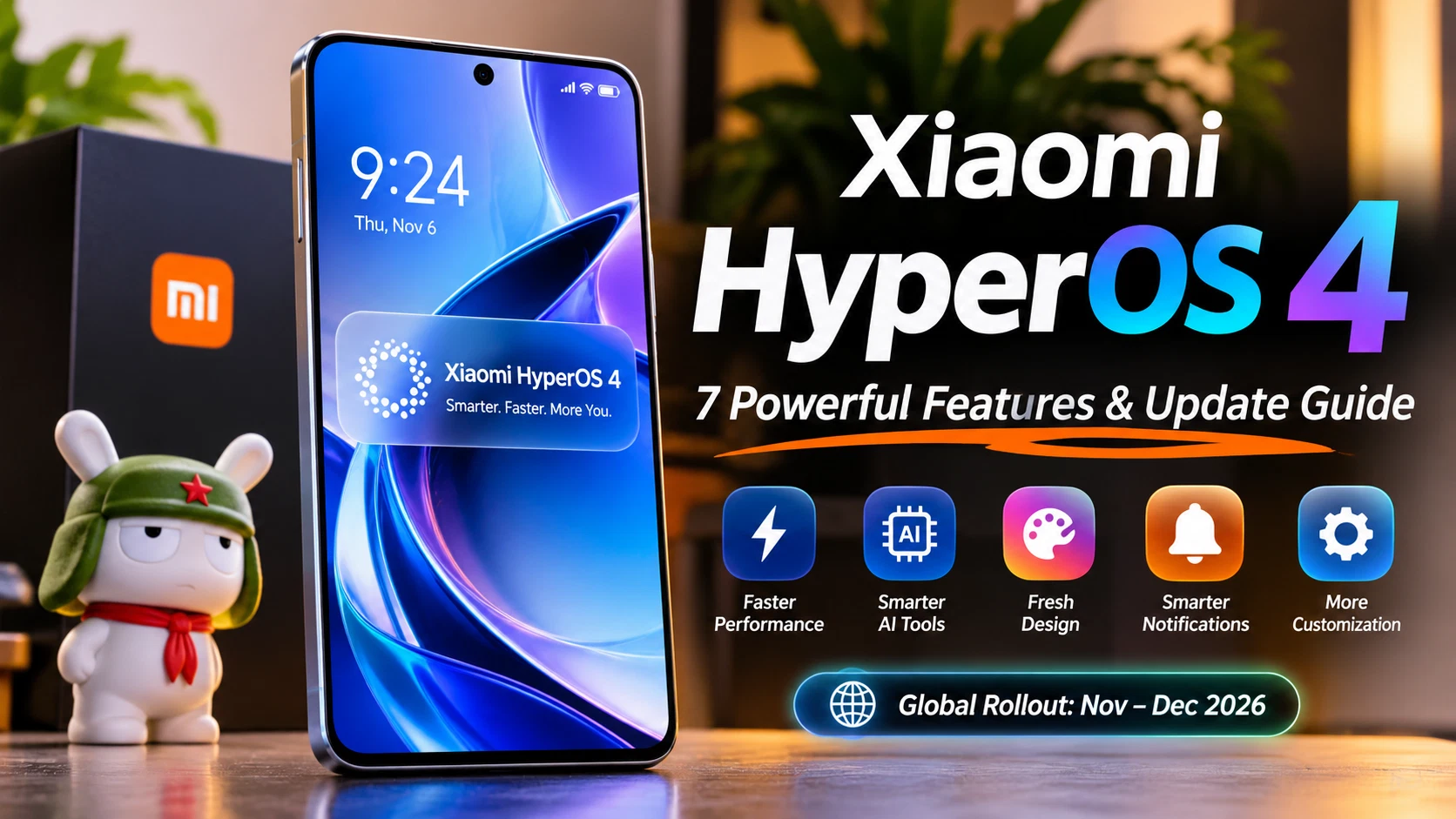
Xiaomi HyperOS 4: 7 Powerful Features and Update Guide
Xiaomi HyperOS 4 is the latest major software upgrade for Xiaomi, Redmi, and POCO devices. The new update introduces a redesigned Soft Light Glass interface, improved system performance, smarter AI tools, and additional customization options.
Xiaomi has officially published its global rollout schedule, with eligible devices receiving the stable update in phases starting in November 2026 and continuing through December.
The update brings several improvements to everyday smartphone use, including stacked notifications, resizable folders, advanced lock screen customization, and AI-powered productivity tools.
In this guide, we explore the 7 best Xiaomi HyperOS 4 features, compatible devices, performance improvements, and the latest global update schedule.
What Is Xiaomi HyperOS 4?
Xiaomi HyperOS 4 is the latest generation of Xiaomi’s software platform, designed to improve the experience across its smartphones, tablets, and connected devices.
The update focuses on three major areas:
Visual experience: A redesigned interface with Soft Light Glass effects and additional customization.
Performance: Improved application launching, memory management, and system responsiveness.
Artificial intelligence: New AI-powered tools for voice recognition, translation, image searching, and productivity.
HyperOS 4 is reported by technology publications to be based on Android 17, although Xiaomi’s official global feature page focuses primarily on its own software improvements.
According to Xiaomi’s official announcement, the global stable rollout begins in November 2026 and continues into December.
Source: Xiaomi Official HyperOS 4 Website.
7 Best Xiaomi HyperOS 4 Features
1. Soft Light Glass: A Completely Redesigned Interface
One of the biggest changes in Xiaomi HyperOS 4 is its new Soft Light Glass design.
The redesigned interface introduces translucent visual layers, ambient colours, light effects, and improved visual depth. These changes make the software look more modern while maintaining a clear interface.
Its main visual improvements include:
Refined transparency effects.
Dynamic lighting responses.
Improved visual transitions.
Better use of shadows and background colours.
More detailed interface layers.
The interface also responds to user interactions with dynamic lighting effects, making everyday navigation feel more interactive.
However, some visual effects depend on the device model and hardware capabilities.
2. Customizable Lock Screen and Flexible Clocks
HyperOS 4 introduces additional lock screen customization options.
Users can adjust clock sizes and typography to create a more personalized appearance. Flexible clock scaling allows users to change how information appears on their screens.
These improvements are useful for people who prefer a clean and customized lock screen.
Xiaomi also notes that advanced lock screen styling is available only on selected devices.
3. Stacked Notifications and Resizable Folders
Xiaomi is improving everyday smartphone navigation with additional home screen and notification features.
Notification stacking
HyperOS 4 introduces stacked notifications to create a cleaner notification panel. Users can browse grouped notifications more conveniently instead of dealing with a long list of individual alerts.
Resizable home screen folders
Users can resize supported home screen folders to organize applications according to their preferences.
Widget stacking
Widget stacking helps users organize multiple widgets more efficiently while maintaining a cleaner home screen.
Together, these changes improve home screen organization and make everyday smartphone interactions more convenient.
4. Faster Performance and Improved Memory Management
Performance is another major focus of Xiaomi HyperOS 4.
Xiaomi introduces three technologies to improve system responsiveness:
Precision Workload Scheduling
Memory Preloading
Application Runtime Environment
These technologies are designed to improve resource management, prepare memory more efficiently, and optimize the performance of system applications.
Xiaomi has also published performance comparisons between HyperOS 3 and HyperOS 4.
According to its internal laboratory testing:
| Performance test | HyperOS 3 | HyperOS 4 |
|---|---|---|
| 30-app launch time after 9 hours | 40.3 seconds | 36.8 seconds |
| Rear-camera HDR capture | 313.38 ms | 240.16 ms |
| Camera cold launch | 1,043.6 ms | 808.8 ms |
Xiaomi reports an 8.7% reduction in the total launch time of 30 applications after nine hours of use.
These results were obtained through Xiaomi’s internal testing using the Xiaomi 17 Ultra under controlled conditions. Actual performance may vary depending on the device, applications, and usage patterns.
5. Xiaomi HyperAI Voice Notes
HyperOS 4 expands Xiaomi’s AI-powered productivity features.
AI Voice Notes is designed to make recording and organizing spoken information easier.
Its announced capabilities include:
Voice memo recording.
Automatic organization of recorded information.
AI-powered questions and answers.
Extraction of important tasks.
Conversion of information into mind maps.
These capabilities could be useful for students, professionals, and people who regularly record meetings or personal notes.
However, AI feature availability depends on supported devices, languages, and regions.
6. AI Speech Recognition and Smart Summaries
Another important improvement is Xiaomi’s AI-powered speech recognition experience.
It is designed to help users understand, organize, and review recorded information.
Announced capabilities include:
Speech transcription.
Meeting context recognition.
Automatic summaries and key takeaways.
Image markers inside recordings.
Skipping silent sections.
Automatically generated outlines.
For example, someone recording a long meeting can use these tools to find important information without manually reviewing the entire recording.
This makes HyperOS 4 more useful for everyday productivity.
7. More Xiaomi HyperAI Tools
Xiaomi is also expanding its HyperAI ecosystem with additional intelligent features.
AI Answers: Combines web search and multimodal intelligence to provide answers.
AI Translate Conversation: Helps translate face-to-face conversations.
AI Gallery Search: Makes it easier to locate specific photographs using intelligent search.
AI Creativity Assistant: Provides AI-powered tools for editing and creating visual content.
These tools aim to improve communication, photography, and everyday productivity.
Not every feature will be available on every Xiaomi device. Language, regional availability, and internet connectivity can also affect access.
Xiaomi HyperOS 4 Eligible Devices and Global Rollout Schedule
Xiaomi has published an official global rollout schedule covering Xiaomi, Redmi, and POCO smartphones and tablets.
The rollout is divided into three phases.
Early November 2026
The first rollout phase includes:
Xiaomi
Xiaomi 17 Ultra
Xiaomi 17
Xiaomi 17T Pro
Xiaomi 17T
Redmi
Redmi Note 15 series
Redmi 17 series
Redmi 15C series
POCO
POCO F8 Ultra
POCO F8 Pro
POCO X8 Pro series
POCO M8 series
POCO C95 Pro
POCO C85
Tablets
Xiaomi Pad 8
Xiaomi Pad 8 Pro
Mid-November 2026
The second rollout phase includes:
Xiaomi
Xiaomi 15 Ultra
Xiaomi 15
Xiaomi 15T Pro
Xiaomi 15T
Redmi
Redmi Note 17 series
POCO
POCO F9 series
POCO F7 series
POCO X8
POCO X7 Pro series
Tablets
Xiaomi Pad 7 series
Xiaomi Pad Mini
Redmi Pad 2 Pro series
POCO Pad X1
POCO Pad M1
December 2026
The final announced phase includes:
Xiaomi
Xiaomi MIX Flip
Xiaomi 14 series
Xiaomi 13 series
Xiaomi 14T series
Xiaomi 13T series
Redmi
Redmi Note 14 series
Redmi 15 series
Redmi 14S
Redmi A7 Pro
POCO
POCO F6 series
POCO X8s
POCO X7
POCO X6 Pro
POCO M8s 5G
POCO M7
POCO C81 Pro
Tablets
Xiaomi Pad 6S Pro 12.4
Redmi Pad 2 series
POCO Pad C1
Important: These are the main device families in Xiaomi’s published global schedule, not a guarantee that every regional variant will receive the update at the same time. The rollout schedule is estimated and subject to changes based on region, carrier, device model, and development progress.
For the complete list, visit Xiaomi’s official HyperOS 4 rollout page.
How to Download and Install Xiaomi HyperOS 4
If your device is included in the official rollout, you can check for the update through your phone’s settings.
Follow these steps:
Open Settings on your Xiaomi, Redmi, or POCO phone.
Tap About Phone.
Open the HyperOS software version section.
Select Check for Updates.
If the update is available, review the version information.
Download and install the update.
Before installing, consider these precautions:
Back up important photos, documents, and other files.
Connect your phone to a stable Wi-Fi network.
Keep sufficient free storage available.
Make sure your battery is adequately charged.
Avoid interrupting the installation process.
If the update does not appear, your device may be scheduled for a later rollout phase. Avoid installing unofficial firmware simply to receive the update earlier.
Is Xiaomi HyperOS 4 Better Than HyperOS 3?
HyperOS 4 introduces several improvements over its predecessor, particularly in interface design, customization, and AI-powered features.
Its Soft Light Glass interface provides a refreshed visual experience, while notification stacking and resizable folders improve everyday usability.
Xiaomi also reports improvements in application launching and camera responsiveness through its internal performance tests.
However, the overall experience depends on the device. Some older and budget models may receive fewer features because of hardware limitations.
For existing Xiaomi, Redmi, and POCO users, HyperOS 4 offers meaningful reasons to consider upgrading when the stable version becomes available.
Frequently Asked Questions
Is Xiaomi HyperOS 4 based on Android 17?
Technology publications report that HyperOS 4 is based on Android 17. It combines the Android platform with Xiaomi’s customized interface and additional software features.
When will Xiaomi HyperOS 4 be available globally?
The official global rollout schedule begins in early November 2026, expands in mid-November, and continues through December 2026.
Which phones will receive Xiaomi HyperOS 4?
Eligible devices include selected Xiaomi 17, Xiaomi 15, Xiaomi 14, Redmi Note 15, Redmi Note 14, POCO F8, POCO F7, and other supported models.
Does HyperOS 4 improve battery life?
Xiaomi highlights performance and memory-management improvements, but it has not established a universal battery-life improvement for every supported device. Actual battery performance depends on the model and usage.
Will every Xiaomi phone receive HyperOS 4?
No. The update is intended for selected supported devices. Older or unsupported models may not receive the new version.
How can I check whether my phone is eligible?
Visit Xiaomi’s official HyperOS 4 rollout page or check the system update section in your phone’s settings.
Final Verdict
Xiaomi HyperOS 4 is more than a visual redesign. Its combination of Soft Light Glass, improved performance management, AI-powered productivity tools, and additional customization makes it an important upgrade for the Xiaomi ecosystem.
The global rollout schedule is particularly useful because Xiaomi, Redmi, and POCO owners can check when their devices are expected to receive the update.
For the best experience, follow Xiaomi’s official announcements and wait for the stable release for your specific device rather than relying on unofficial installation packages.
Official source: Xiaomi HyperOS 4 – Features and Global Rollout Schedule