Upcoming WhatsApp Features 2026: 10 New Updates Coming to WhatsApp
WhatsApp is getting more than simple messaging updates in 2026. The platform is expanding into privacy, AI, account management, calling, personalization, and cross-device communication, with several new features already rolling out and others still being tested.
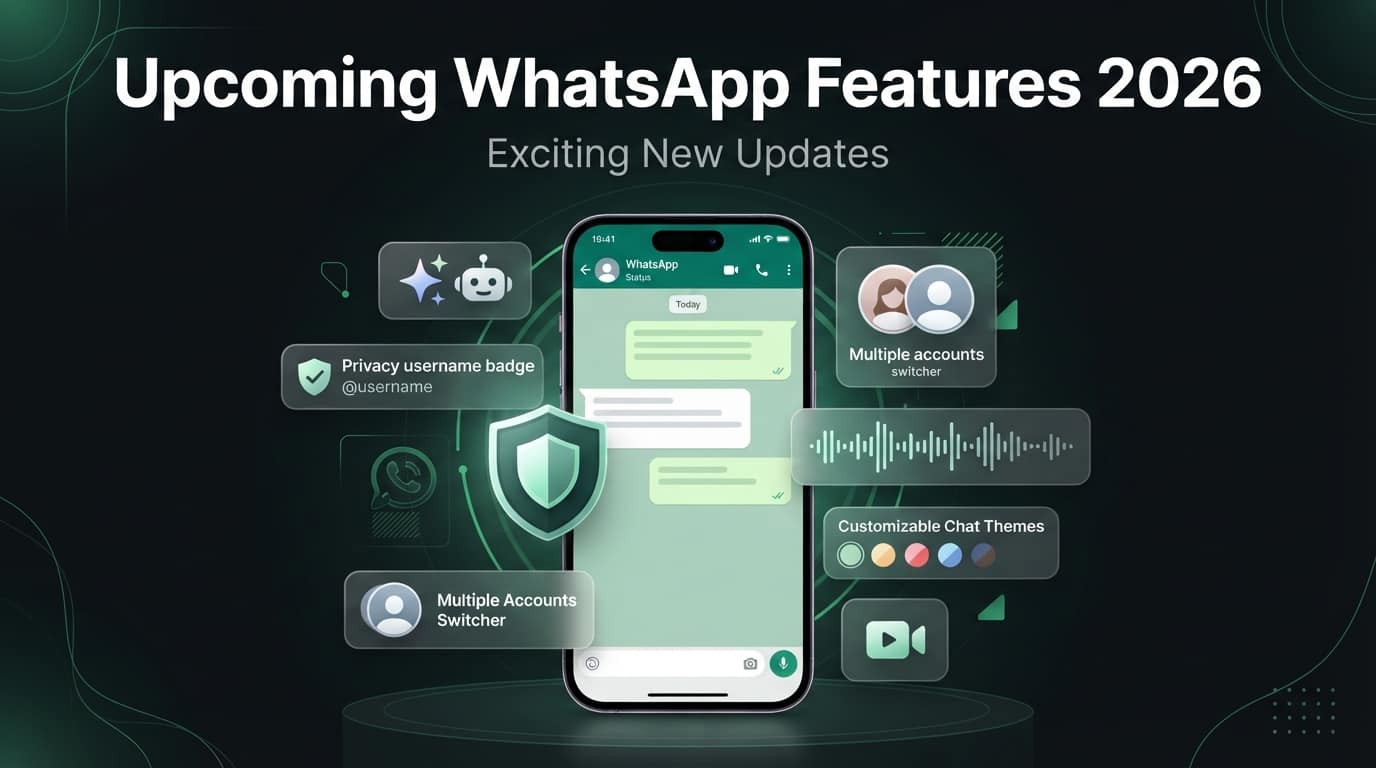
The biggest upcoming WhatsApp features in 2026 include usernames, stronger account security, additional account support on iPhone, synchronized chat themes, expanded voice transcription, AI-powered experiences, and new calling tools. However, availability depends on your device, country, account, and whether WhatsApp has enabled a feature for you.
Here is what WhatsApp is working on and what you can expect next.
Upcoming WhatsApp Features in 2026
Before looking at each feature, it is important to understand their current status.
Some features below have been officially announced by WhatsApp, while others are appearing in beta versions or are gradually rolling out to users.
| WhatsApp feature | Status | Main benefit |
|---|---|---|
| WhatsApp usernames | Officially announced | Hide your phone number from new contacts |
| Stronger two-step verification | Rolling out | Better account protection |
| More information for unknown callers | Rolling out | Identify suspicious calls |
| Three WhatsApp accounts on iPhone | In testing | Manage more accounts |
| Shared chat themes | In testing | Synchronize chat appearance |
| Expanded voice transcription | Rolling out | Read voice messages as text |
| AI and personal agents | Expanding | Complete tasks through AI |
| WhatsApp Web calling | Rolling out | Make calls from your browser |
| Call transfer | Rolling out | Move calls between devices |
| Calling waiting rooms | Rolling out | Control who joins group calls |
Because beta features can change before public release, you should not assume that every feature listed as “in testing” will immediately appear on your phone.
1. WhatsApp Usernames Could Change How You Share Your Number
One of the biggest upcoming WhatsApp features is usernames.
WhatsApp officially announced usernames in June 2026 and opened username reservations ahead of the wider launch. The feature is designed to let people connect without immediately revealing their phone number.
This could be particularly useful when you are talking to someone you have just met, joining a community, contacting a business, or participating in a group where you do not want everyone to have your personal number.
With a username enabled, someone contacting you for the first time would see your username rather than your phone number.
WhatsApp says there will not be a public directory of usernames. Instead, people will need to know the exact username to contact you. The company is also developing an optional username key that provides another layer of control over who can start a conversation.
When will WhatsApp usernames launch?
WhatsApp says usernames will roll out gradually during 2026, with availability depending on the user’s country.
You can also reserve a username through the latest WhatsApp version by going to:
Settings → Account → Username
The feature is therefore more than a rumor; WhatsApp has officially announced it.
However, the rollout is gradual, so not everyone will immediately be able to use a username.
2. WhatsApp Is Making Account Security Stronger
Security is another major focus of WhatsApp’s 2026 updates.
In August, WhatsApp announced stronger two-step verification that replaces the traditional six-digit PIN with a more flexible password containing letters, numbers, and special characters.
This gives users another layer of protection if someone obtains their one-time verification code.
WhatsApp is also providing additional information when an unknown person calls you on Android.
For example, you may see whether the caller is using a number from another country or whether you have groups in common.
That information can help you decide whether an unfamiliar call deserves your attention.
WhatsApp passkeys are also expanding
WhatsApp says more than one billion people have configured a passkey.
Passkeys allow users to authenticate using methods such as Face ID, a fingerprint, or their device’s screen lock rather than relying on traditional verification codes.
WhatsApp has also added support for multiple passkeys when people use both Android and iOS devices.
These changes make account recovery and login security an increasingly important part of WhatsApp’s development.
3. iPhone Could Get Support for Three WhatsApp Accounts
WhatsApp already supports multiple accounts on compatible devices, but the company is testing a further expansion on iPhone.
Current beta reporting indicates that WhatsApp is testing support for up to three accounts on iOS, compared with the existing two-account setup.
The idea is useful for people who separate their communication across different numbers.
For example, you could potentially have:
- Personal account
- Work account
- Secondary account
inside the same WhatsApp application.
Each account can maintain its own chats and settings instead of forcing users to constantly log in and out.
This feature is currently in testing, so WhatsApp could change the implementation before a wider release.
4. WhatsApp Is Testing Shared Chat Themes
WhatsApp has been adding more customization to conversations, and the next step could make themes collaborative.
According to current beta reporting, WhatsApp is testing a feature that allows users to synchronize a chat theme with other people in a conversation.
The feature can potentially apply elements such as:
- Wallpaper
- Message-bubble colors
- Chat theme
to everyone in an individual or group conversation.
This would be different from the traditional system where a theme primarily changes how the conversation looks on your own device.
For example, a group planning a trip could use the same theme across the conversation.
The feature is still being tested, so the final version could work differently.
5. WhatsApp Voice Transcription Is Expanding
WhatsApp continues to improve its voice-message transcription system.
Recent Android updates have introduced additional language packs for voice-message transcriptions. These allow supported voice messages to be converted into text so you can read them without listening to the entire recording.
An important part of this system is that the language packs can be downloaded locally.
That means transcription can happen on the device rather than requiring every voice message to be sent to a remote server for processing.
Why voice transcription matters
Voice messages are convenient, but they are not always practical.
You may be:
- In a meeting
- In a quiet public place
- Without headphones
- Somewhere you cannot play audio
- Looking for one specific part of a long voice note
Text transcription gives you another way to consume the same information.
WhatsApp is therefore turning voice messages into a more flexible communication format rather than forcing users to choose between audio and text.
6. AI Is Becoming a Bigger Part of WhatsApp
Artificial intelligence is becoming one of the most important directions for Meta’s messaging ecosystem.
Meta’s latest personal AI agent, Muse, can be accessed directly through WhatsApp. Meta describes Muse as an agent that can do more than answer questions: it can work on tasks, create plans, interact with services, and continue working after a user leaves the app.
Meta says Muse is initially rolling out in the United States on iOS, Android, and the web.
The bigger development here is the shift from AI as a chatbot to AI as an agent.
A traditional chatbot mainly responds to a question.
An AI agent can potentially take actions on your behalf.
That could eventually make WhatsApp useful for tasks such as planning, research, reminders, customer communication, and other workflows.
Availability and capabilities will vary as Meta continues expanding the technology.
7. AI Is Also Coming to WhatsApp Business Workflows
AI is not only being developed for ordinary WhatsApp users.
Meta is also making it easier for businesses to use AI agents with WhatsApp Business.
In September 2026, Meta announced that developers can use AI agents to help set up and manage WhatsApp Business messaging rather than manually moving between multiple Meta development tools.
This is particularly relevant for businesses that use WhatsApp for customer support and sales.
Instead of configuring every component manually, a developer could communicate with an AI agent and describe the required setup.
That shows how WhatsApp is moving toward becoming an AI-assisted business communication platform, not just a messaging app.
8. WhatsApp Web Calling Is Now Expanding
Calling is another area where WhatsApp has received substantial improvements.
WhatsApp officially introduced audio and video calling directly through WhatsApp Web in July 2026.
Users can make one-to-one and group calls through their browser without installing the desktop application.
The web calling experience also supports features such as:
- Screen sharing
- Reactions
- Call history
- Favorites
- Audio calls
- Video calls
WhatsApp says these web calls are end-to-end encrypted.
Call transfer is also available
Another useful addition is call transfer.
You can move an active call from one device to another without ending the conversation.
For example, you could start a call on your phone and transfer it to WhatsApp Web when you sit down at your computer.
That makes WhatsApp more flexible across phones, tablets, and computers.
9. WhatsApp Is Adding More Control to Group Calls
WhatsApp is also giving users greater control over group calls.
Its new calling features include a waiting room for certain group calls.
When a call link is configured to require approval, participants can wait before being admitted to the call.
This is particularly useful for larger conversations where you do not want everyone entering immediately.
WhatsApp has also introduced background-noise suppression and improved video quality at the beginning of calls.
These changes make WhatsApp calls more suitable for situations that previously might have required a dedicated meeting platform.
10. WhatsApp Is Becoming More Connected Across Devices
WhatsApp is also moving beyond the traditional phone-first experience.
In 2026, WhatsApp introduced the ability to create an account directly on iPad without first linking the tablet to a phone.
The company has also upgraded its CarPlay and Android Auto experience so users can interact with messages and calls from compatible vehicle systems.
Other recent improvements include opening and lightly editing PDFs directly in WhatsApp Web and Desktop, plus sharing music from Apple Music or Spotify to WhatsApp Status.
These updates show a broader strategy: WhatsApp is increasingly designed to follow you across the devices and services you already use.
What These WhatsApp Updates Mean for Users
The biggest change is not any single feature.
It is the direction WhatsApp is taking.
Privacy: Usernames can reduce the need to expose your phone number to new contacts.
Security: Stronger two-step verification, passkeys, and additional caller information provide more account-protection tools.
AI: Meta is moving from simple AI answers toward agents capable of performing tasks.
Productivity: Voice transcription, web calling, call transfer, and multi-account support reduce friction during everyday use.
Personalization: Shared themes and other customization tools give users more control over how conversations look.
Cross-device communication: iPad, browser, car systems, and desktop improvements make WhatsApp less dependent on a single smartphone.
Instead of becoming only a more feature-packed messenger, WhatsApp is gradually becoming a broader communication and productivity platform.
Which Upcoming WhatsApp Features Are Actually Confirmed?
This is an important distinction when reading WhatsApp news.
Officially announced by WhatsApp
These include features such as:
- Usernames
- Stronger two-step verification
- Additional unknown-caller context
- Expanded passkey support
- WhatsApp Web calling
- Call transfer
- Group-call waiting rooms
- iPad account registration
These have been publicly announced by Meta or WhatsApp.
Beta or development features
Other features, including:
- Three WhatsApp accounts on iPhone
- Synchronized chat themes
- Additional experimental voice features
are being tested or reported through WhatsApp beta builds.
A beta discovery should therefore not be treated as a guaranteed final feature.
WhatsApp can change, delay, or cancel features before they reach the stable version.
When Will the New WhatsApp Features Be Available?
There is no single release date for all upcoming WhatsApp features in 2026.
WhatsApp typically releases features gradually.
The process can look like:
Development → Beta testing → Limited rollout → Wider rollout → General availability
Even after a feature reaches a stable WhatsApp version, it may not immediately appear for every user.
Availability can depend on:
- Android or iPhone
- Country
- WhatsApp version
- Account
- Server-side activation
- Beta participation
Therefore, updating WhatsApp is important, but an update alone does not guarantee access to every new feature.
How to Get New WhatsApp Features Early
The safest way to receive new WhatsApp features is to keep the official app updated through the Google Play Store or Apple App Store.
Android and iPhone users can also participate in official beta testing when enrollment is available.
However, beta access should not be confused with guaranteed early access.
WhatsApp frequently enables features gradually, so one beta tester may receive a feature while another user on the same version does not.
You should also avoid unofficial modified versions of WhatsApp that promise access to hidden features.
Those applications can create unnecessary privacy and security risks.
Frequently Asked Questions
What are the biggest upcoming WhatsApp features in 2026?
The biggest developments include WhatsApp usernames, stronger account security, additional account support on iPhone, synchronized chat themes, expanded voice transcription, AI agents, improved web calling, and better cross-device support.
Is WhatsApp getting usernames?
Yes. WhatsApp officially announced usernames in June 2026 and began allowing users to reserve them ahead of the wider rollout. The feature is designed to help people connect without immediately sharing their phone number.
Can WhatsApp have three accounts on one iPhone?
WhatsApp is testing support for up to three accounts on iOS. The feature is not yet a general release and may change before becoming widely available.
Is WhatsApp adding AI features?
Yes. Meta is expanding AI inside its messaging ecosystem, including its Muse personal AI agent, which can be accessed through WhatsApp in supported markets. Meta is also expanding AI tools for WhatsApp Business.
Can WhatsApp transcribe voice messages?
Yes. WhatsApp supports voice-message transcription in supported languages, and additional language packs are being rolled out. Recent versions can use locally downloaded language packs on Android.
Is WhatsApp adding new security features?
Yes. WhatsApp has announced stronger two-step verification, additional information for calls from unknown contacts, and expanded passkey support.
Can I make WhatsApp calls from a browser?
Yes. WhatsApp has introduced audio and video calling through WhatsApp Web, including one-to-one and group calls.
Why don't I have a new WhatsApp feature yet?
WhatsApp usually rolls out new features gradually. Your device, country, app version, account, and server-side availability can all affect when a feature appears.
Final Thoughts
The upcoming WhatsApp features in 2026 show that WhatsApp is evolving well beyond traditional text messaging.
Usernames are putting more emphasis on privacy, stronger authentication is improving account protection, and multi-account support could make WhatsApp more practical for people who use separate numbers.
At the same time, AI is becoming a much bigger part of the platform. Meta’s move toward AI agents suggests that future WhatsApp experiences could involve not only sending messages but also getting tasks completed through conversations.
Calling is evolving too, with WhatsApp Web calling, call transfers, waiting rooms, and noise suppression making the service more useful across phones and computers.
The important thing to remember is that not every upcoming feature is available today. Some are official rollouts, while others are still being tested. If you want the newest WhatsApp features, keep the official app updated and watch for gradual account-level rollouts.
As WhatsApp continues developing its privacy, AI, calling, security, and personalization tools, 2026 could become one of the platform’s most significant years of feature expansion.