iPhone 18 Pro Max vs Xiaomi 18 Pro Max: Which Wins?
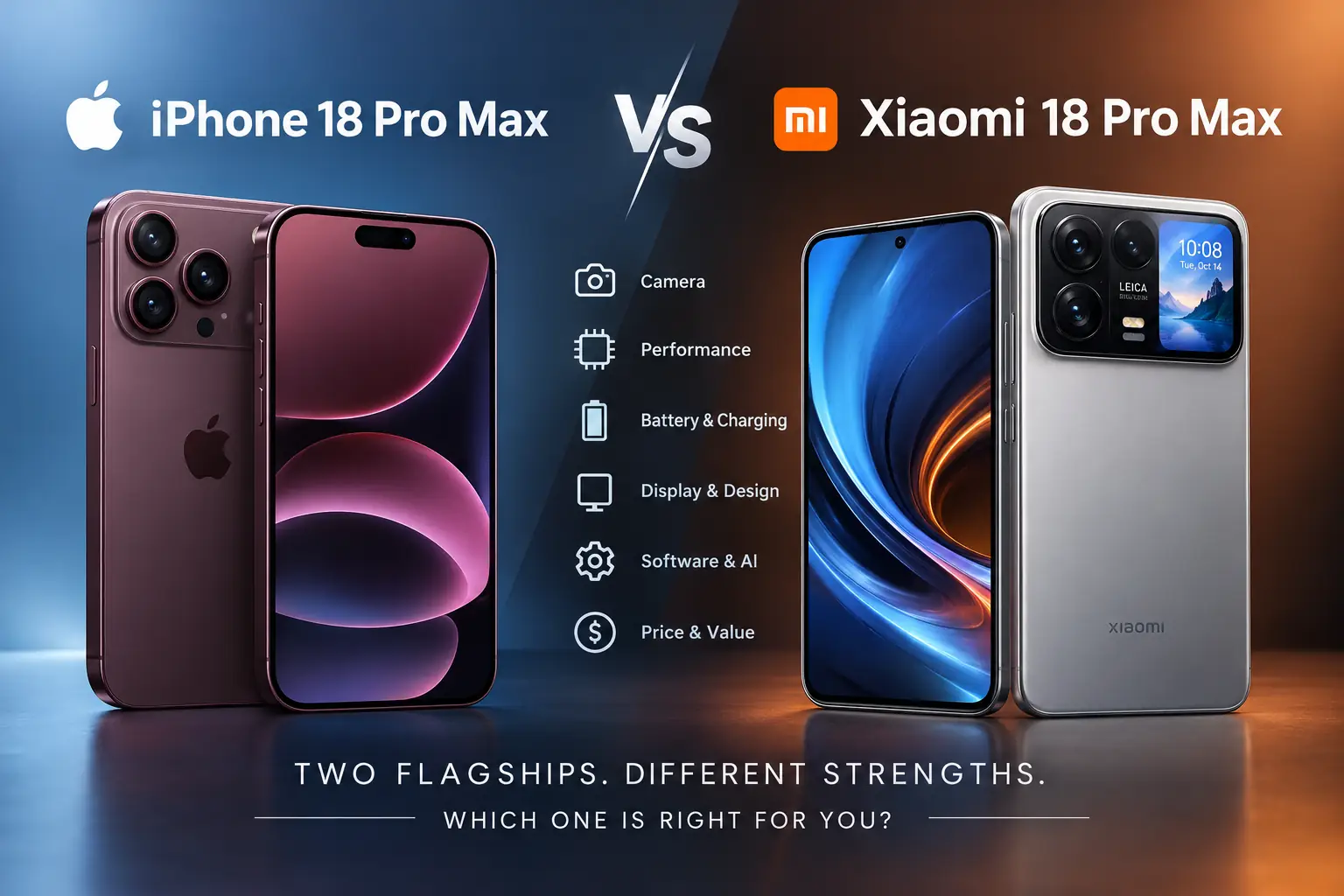
The iPhone 18 Pro Max vs Xiaomi 18 Pro Max comparison comes down to two different approaches to flagship smartphones. Apple’s iPhone focuses on the iOS ecosystem, advanced video features, and the A20 Pro chip. Xiaomi counters with a high-resolution camera system, a much larger advertised battery in its Chinese model, and faster charging.
Both phones have a 6.9-inch display, but their differences matter more than their screen sizes. Xiaomi looks particularly appealing for battery capacity and charging, while Apple’s camera controls, video capabilities, and ecosystem make the iPhone a compelling choice for creators and existing Apple users.
Quick answer: Choose the iPhone 18 Pro Max if you prioritize iOS, video recording, and Apple’s ecosystem. Consider the Xiaomi 18 Pro Max if you prefer Android, faster charging, and its distinctive camera hardware. However, Xiaomi’s battery and camera advantages on paper do not automatically prove better real-world results.
iPhone 18 Pro Max vs Xiaomi 18 Pro Max: Specifications Compared
The following table summarizes the key specifications reported by PhoneArena, NanoReview, and Apple’s official announcement.
| Feature | iPhone 18 Pro Max | Xiaomi 18 Pro Max |
|---|---|---|
| Display | 6.9-inch OLED | 6.9-inch AMOLED |
| Refresh rate | Up to 120Hz | 1–120Hz adaptive |
| Processor | Apple A20 Pro | Snapdragon 8 Elite Extreme Gen 6 |
| Operating system | iOS 27 | Android-based HyperOS 4 |
| Main camera | 48MP, variable aperture | 200MP |
| Telephoto camera | 48MP periscope, 4x optical zoom | 200MP periscope, 3.2x optical zoom |
| Ultrawide camera | 48MP | 50MP |
| Battery capacity | Market-dependent; listed as 5,391–5,567mAh by PhoneArena | 8,500mAh listed for the Chinese model |
| Wired charging | Listed at 60W by PhoneArena | Listed at 100W |
| Wireless charging | Listed at 25W | Listed at 50W |
| Storage | 256GB to 2TB | Up to 1TB in listed configurations |
| Weight | 249g | Approximately 235g |
| Special feature | Variable-aperture main camera | Secondary rear display and privacy-display feature |
Important: Specifications can vary by market, and third-party databases may update their listings. Check the exact model and regional specification before buying. Xiaomi’s Chinese battery capacity should not be assumed to apply to every potential global variant.
1. Design and Display: Which Phone Feels Better?
Both smartphones offer large 6.9-inch displays designed for watching videos, gaming, browsing, and multitasking. The size is similar, but the display technologies and extra features create different experiences.
The iPhone 18 Pro Max combines its OLED panel with Apple’s iOS interface and Dynamic Island. It is a strong fit for people who regularly use Apple services, AirPods, Macs, or other devices in the same ecosystem.
Xiaomi’s AMOLED display also supports an adaptive refresh rate of up to 120Hz. Its secondary rear display adds another dimension to the design, giving users additional ways to interact with the phone and frame rear-camera selfies.
Xiaomi is listed at approximately 235g, compared with the iPhone’s 249g. That 14g difference may be noticeable when holding a large phone for extended periods, although comfort also depends on balance, thickness, and case choice.
Which is better? Both are premium large-screen phones. Xiaomi has a listed weight advantage, while the better display experience depends on brightness, reflections, colour accuracy, and personal preference. Don’t judge screen quality from resolution or advertised peak brightness alone.
2. Camera Comparison: 200MP Xiaomi vs Apple's Variable Aperture
Camera hardware is one of the biggest differences in the iPhone 18 Pro Max vs Xiaomi 18 Pro Max comparison.
Apple uses a triple 48MP rear-camera system. Its main camera introduces a variable aperture, allowing the lens to adjust its opening for different lighting conditions and creative effects. Apple also offers advanced video features, including ProRes recording and 4K Dolby Vision recording at up to 120 frames per second.
Xiaomi takes a different approach with a listed 200MP main camera, a 200MP periscope telephoto camera, and a 50MP ultrawide camera. The higher-resolution sensors offer considerable flexibility for detail and cropping, but megapixel counts alone cannot determine image quality.
Which phone takes better photos?
The answer depends on the type of photography.
Video recording: The iPhone is a strong choice for creators who value stabilization, consistent colour, and advanced recording formats. Digital Camera World’s review highlights the iPhone’s video strengths.
Zoom photography: Xiaomi’s 200MP periscope camera offers substantial resolution, while the iPhone’s listed telephoto camera provides 4x optical zoom compared with Xiaomi’s 3.2x. Zoom quality also depends on sensor size, optics, processing, and the lighting.
Low-light photos: Apple’s variable aperture offers more control over light and depth of field. Xiaomi’s larger-resolution sensors may be useful, but sensor resolution alone cannot establish which phone performs better at night.
Ultrawide photos: The iPhone has a listed 48MP ultrawide camera, while Xiaomi lists a 50MP unit. A fair winner requires comparable sample images, not a megapixel comparison.
Selfies: Xiaomi’s rear display could help users frame selfies with the rear cameras. The iPhone offers Apple’s own camera interface and processing.
For more background on Apple’s camera approach, read our iPhone 18 Pro camera upgrades guide.
Camera verdict: The iPhone is the more defensible choice for buyers prioritizing its established video workflow and creative controls. Xiaomi’s camera hardware looks impressive, especially on paper, but we should not declare it the better photography phone without comparable independent testing.
3. Performance and Gaming: A20 Pro vs Snapdragon
The iPhone 18 Pro Max uses Apple’s A20 Pro chip, while Xiaomi uses the Snapdragon 8 Elite Extreme Gen 6 listed in comparison databases.
Both are positioned as flagship processors. They are designed for demanding applications, high-end gaming, image processing, and AI-related workloads.
Benchmark results require careful interpretation. NanoReview’s comparison reports the iPhone ahead in its listed Geekbench 6 single-core results, while Xiaomi scores higher in the listed AnTuTu result. Those tests measure different aspects of performance, and the listed AnTuTu sample counts are limited.
In everyday use, performance also depends on software optimization, memory management, thermal behaviour, and how well a phone maintains speed during long gaming sessions.
The iPhone’s A20 Pro and redesigned thermal system are intended to improve sustained performance. Xiaomi’s processor and Android software provide another high-end platform, with flexibility for users who prefer Android.
Gaming verdict: Neither phone should be declared the universal winner from one benchmark. Look for sustained frame rates, heat, power consumption, and performance after extended play before choosing based on gaming alone.
4. Battery Life and Charging: Xiaomi Has the Capacity Advantage
Battery capacity is one of Xiaomi’s clearest specification advantages. PhoneArena lists an 8,500mAh silicon-carbon battery for the Chinese Xiaomi 18 Pro Max, compared with an iPhone battery listed at 5,391–5,567mAh depending on variant.
Xiaomi is also listed with 100W wired and 50W wireless charging. PhoneArena lists the iPhone at 60W wired and 25W wireless charging.
These numbers suggest Xiaomi has the advantage in battery capacity and charging power. However, charging wattage is not the same as actual charging time, and battery capacity does not directly translate into screen-on hours.
There is another important limitation: PhoneArena’s comparison provides iPhone battery test results but marks Xiaomi’s corresponding battery tests as untested. That means we cannot responsibly claim Xiaomi lasts a specific number of hours longer.
Apple states that the iPhone 18 Pro Max’s eSIM-only models offer up to 45 hours of video playback under Apple’s test conditions. This manufacturer figure should not be directly compared with a third-party browsing or gaming test.
Battery verdict: Xiaomi leads on listed battery capacity and charging specifications. The iPhone has published battery claims and independent test data, while a fair real-world endurance comparison requires the same test conditions.
5. Software, AI, and Long-Term Use
The software difference may matter more than a camera specification or benchmark score.
The iPhone 18 Pro Max runs iOS 27 and includes Apple Intelligence features, including Apple’s announced Siri AI experience. Apple also emphasizes privacy and integration with its wider ecosystem. Availability of particular AI features can vary by language, region, and rollout status.
Xiaomi runs Android-based HyperOS 4. Android generally offers more flexibility in interface customization, app installation options, and system-level choices. Xiaomi’s rear display and additional hardware features also contribute to its own software experience.
Before buying either device, consider the devices you already own. If you use a Mac, Apple Watch, AirPods, and iCloud, the iPhone may fit naturally into your routine. If you prefer Android customization and Xiaomi devices, the Xiaomi may be more convenient.
Also check the manufacturer’s official software-support commitment for the exact model. Do not assume that both phones will receive the same number of major updates or security patches.
Software verdict: Choose iOS for Apple’s ecosystem and familiar workflow; choose HyperOS if you prefer Android flexibility. Neither platform is automatically better for every user.
6. Price and Availability: Check Your Market First
Apple announced a US starting price of $1,299 for the iPhone 18 Pro Max, with 256GB storage. The UK launch price has been reported at £1,299. Prices can change with retailer promotions, taxes, storage capacity, and carrier offers.
Xiaomi’s Chinese model has its own regional pricing and configuration. Do not compare a Chinese retail price directly with a UK or US price without accounting for taxes, import costs, warranty, and storage.
Before purchasing Xiaomi outside China, confirm:
Whether the exact model is officially sold in your country.
Whether the battery and other specifications match the Chinese version.
Whether local network bands, SIM options, and 5G support are compatible.
Whether the warranty and repair service are available locally.
Whether the phone’s software and AI features support your language and region.
For the iPhone, check Apple’s local store or an authorized retailer. For Xiaomi, use the official regional website or a reputable local seller. A cheaper imported phone may not offer the same warranty or regional features as a locally supported model.
7. Pros and Cons
iPhone 18 Pro Max
Pros
A20 Pro chip and premium performance platform.
Triple 48MP camera system with variable aperture.
Advanced video features and Apple’s creator-focused workflow.
iOS integration with Apple’s wider ecosystem.
Up to 2TB of listed storage.
Cons
Premium purchase price.
Large 249g body.
Less flexibility than Android for some system-level tasks.
Its camera advantage over Xiaomi cannot be established by specifications alone.
Xiaomi 18 Pro Max
Pros
8,500mAh battery listed for the Chinese model.
100W wired and 50W wireless charging listed.
200MP main and 200MP periscope camera hardware.
Secondary rear display and privacy-display feature.
Android-based HyperOS experience and listed lower weight.
Cons
Regional availability and specifications need careful verification.
Xiaomi’s battery and camera test results are not fully available in the cited comparison.
Chinese and global versions may differ.
High megapixel counts do not guarantee better photos.
8. Which Phone Should You Buy?
The best choice depends on what you value most.
Choose the iPhone 18 Pro Max if:
You record videos frequently and value advanced video controls.
You already use Apple’s ecosystem.
You prefer iOS and Apple’s approach to software integration.
You want storage options up to 2TB.
Consider the Xiaomi 18 Pro Max if:
You prefer Android and HyperOS.
Battery capacity and charging speed are high priorities.
You want a high-resolution periscope camera and a secondary rear display.
You can verify that the exact regional model, warranty, and network support meet your needs.
Final verdict
The iPhone 18 Pro Max vs Xiaomi 18 Pro Max comparison does not have one universal winner. Apple offers a compelling combination of video features, ecosystem integration, and the A20 Pro platform. Xiaomi counters with impressive listed battery and charging specifications, high-resolution camera hardware, and more Android flexibility.
On specifications alone, Xiaomi looks particularly attractive for buyers who prioritize battery capacity and charging. The iPhone is the safer recommendation for users who specifically want iOS and Apple’s video workflow. Camera quality, gaming endurance, and total battery life should remain open questions until comparable independent tests are available.
Before making a final purchase, compare the actual price of the same storage capacity in your country and verify the exact regional model.
Frequently Asked Questions
Is the iPhone 18 Pro Max better than the Xiaomi 18 Pro Max?
It depends on your priorities. The iPhone is a strong option for iOS, video recording, and Apple’s ecosystem. Xiaomi has stronger listed battery capacity and charging specifications. A universal winner would require comparable real-world testing.
Which phone has the better camera?
The iPhone has a triple 48MP camera system with variable aperture and advanced video features. Xiaomi lists a 200MP main camera and a 200MP periscope telephoto camera. These specifications show different strengths, but they do not establish an overall winner without comparable photo and video samples.
Does the Xiaomi 18 Pro Max have better battery life?
Its Chinese model is listed with an 8,500mAh battery, which is larger than the iPhone’s listed capacity. However, PhoneArena marks Xiaomi’s battery tests as untested, so we cannot confidently state how many extra hours it lasts.
Which phone charges faster?
The listed specifications favour Xiaomi: 100W wired and 50W wireless charging, compared with PhoneArena’s listed 60W wired and 25W wireless figures for the iPhone. Actual charging times depend on the charger, temperature, and charging conditions.
Is the Xiaomi 18 Pro Max available worldwide?
Availability and regional configurations should be confirmed through Xiaomi’s official local website or an authorized retailer. Do not assume that a Chinese model’s battery, network support, or software features are identical to those of a global variant.
Which phone is better for gaming?
Both use flagship processors. Compare sustained frame rates, heat, battery consumption, and performance over long sessions rather than relying on a single benchmark score.
Should you buy the iPhone 18 Pro Max or Xiaomi 18 Pro Max?
Buy the iPhone if iOS, Apple ecosystem integration, and video features are your priorities. Consider Xiaomi if you prefer Android, fast charging, and its camera hardware. Check regional pricing, warranty, and independent test results before deciding.