
AI Data Centers in Space: Could the Next AI Revolution Move Into Orbit?
Artificial intelligence is creating a huge demand for computing power. Every AI model needs powerful chips, electricity, cooling systems, and space to operate. But building more data centers on Earth is becoming increasingly challenging because of rising energy needs, water consumption, land requirements, and infrastructure costs.
Now, technology companies are exploring an unusual solution: AI data centers in space.
Instead of keeping every AI computer on Earth, the idea is to place powerful computing hardware aboard satellites and connect them into networks. Google’s Project Suncatcher is one of the most interesting efforts in this field. Its first prototype satellite reached orbit in October 2026.
But can satellites really become powerful AI data centers? And could this technology eventually change the future of cloud computing?
Let’s explore how it works, what companies are developing, and the biggest challenges standing in the way.
What Are AI Data Centers in Space?
AI data centers in space are proposed computing facilities that use satellites or other orbital infrastructure to run artificial intelligence workloads.
Like traditional data centers, they would contain computing chips, memory, networking equipment, and power systems. The major difference is their location: instead of operating inside buildings on Earth, the hardware would operate in orbit.
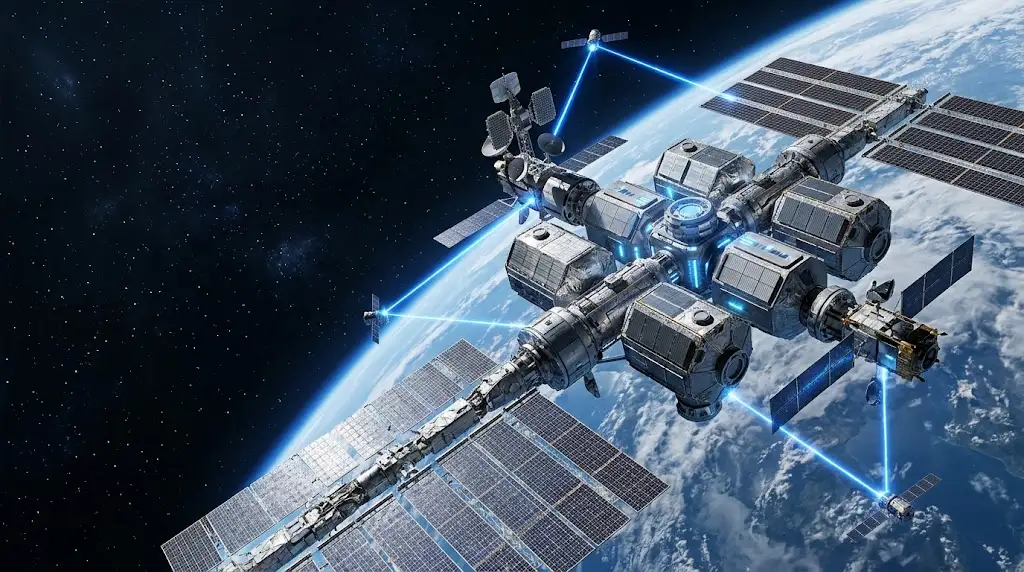
These satellites could work together as a distributed computing network. They would use solar panels to generate electricity and optical communication systems to transfer information between spacecraft.
The goal is not necessarily to move every internet server into space. Instead, companies are exploring whether certain AI workloads could be processed more efficiently outside Earth’s atmosphere.
For example, satellites collecting images of Earth could process that information directly in orbit rather than sending every raw image to a ground-based data center first.
Why Are Companies Exploring Data Centers in Space?
The growing demand for AI computing is putting pressure on traditional data center infrastructure.
Modern AI systems require large amounts of electricity. Data centers also need cooling equipment to prevent powerful processors from overheating. In some locations, access to electricity, water, and suitable land can limit expansion.
Space-based computing offers a different approach to some of these problems.
1. Access to Solar Energy
One of the biggest attractions of space-based data centers is solar power.
Satellites in carefully selected orbits can receive sunlight for much longer periods than solar panels on the ground. Google’s Project Suncatcher research explores a dawn-dusk, sun-synchronous low Earth orbit designed to maximize solar energy collection.
Solar panels could provide electricity directly to onboard computing hardware. This may reduce dependence on large terrestrial power systems, although batteries and power-management equipment would still be necessary.
However, solar power alone does not make an orbital data center cheap. Companies must also pay to manufacture, launch, operate, and eventually replace the equipment.
2. Less Pressure on Earth's Resources
Traditional data centers need physical buildings, electrical infrastructure, cooling systems, and land.
Moving some computing operations into orbit could reduce the demand for those resources on Earth.
A report from the U.S. Government Accountability Office explains that space-based data centers could reduce the land, electricity, and water requirements associated with computing facilities.
That does not mean space infrastructure has no environmental cost. Rockets, satellite manufacturing, launches, and replacements all have their own impacts.
3. Processing Data Closer to Satellites
Space-based AI computing could be particularly useful for processing information collected in space.
Earth-observation satellites, scientific instruments, and other spacecraft generate large amounts of data. Sending everything to Earth can take time and require significant communication capacity.
With onboard AI processors, a satellite could analyze information before transmitting it.
For example, an Earth-observation satellite might identify important changes in a landscape and send only the most useful results to researchers.
This could reduce unnecessary data transfers and help certain applications respond faster.
Google Project Suncatcher: A Real Step Toward AI Data Centers in Space
Google’s Project Suncatcher is a research initiative exploring how solar-powered satellites equipped with Google’s Tensor Processing Units (TPUs) could support machine learning in orbit.
Google announced the project on November 4, 2025. Its long-term concept involves interconnected satellites carrying AI processors and communicating through free-space optical links.
The project became more concrete on October 1, 2026, when Google confirmed that its first Project Suncatcher prototype satellite had launched into orbit aboard SpaceX’s Transporter-18 rideshare mission. The satellite was built in partnership with Planet, and Google confirmed that it had established contact with the spacecraft.
This is an important milestone, but it is not a fully operational AI data center. Google is using the prototype to collect real-world information about how its hardware behaves in space.
How Does Project Suncatcher Work?
Google’s proposed architecture combines three major technologies:
Google TPUs: Specialized processors designed to accelerate machine learning workloads.
Solar panels: Systems that generate electricity from sunlight.
Optical inter-satellite links: Laser-based communication systems that allow satellites to exchange data.
The long-term vision is to connect multiple satellites into a computing cluster. Instead of relying on one enormous spacecraft, Google is investigating a modular network of smaller satellites.
Its research paper describes an illustrative cluster containing 81 satellites within a radius of approximately one kilometre. This is a proposed design model, not an existing operational constellation.
Can Google's AI Chips Survive in Space?
Space is a difficult environment for electronic hardware. Radiation can damage components or cause errors in computer memory and calculations.
Google’s researchers tested its Trillium TPU hardware using a proton beam to investigate radiation tolerance. The research reported that the tested chips showed promising resistance to radiation exposure, including a cumulative dose equivalent to the estimated five-year mission dose under the study’s shielding assumptions.
This is encouraging, but laboratory radiation testing cannot prove that an entire satellite computing system will operate reliably for years in orbit.
Google’s prototype mission is designed to help answer that question through actual space testing.
The research was published in the scientific journal Joule on October 1, 2026. You can read the original Google research paper for its technical details.
Other Companies Are Also Exploring Space-Based Computing
Google is not the only company interested in orbital computing.
One notable example is Starcloud, a startup working on space-based data center technology.
In November 2025, Starcloud launched its Starcloud-1 satellite carrying an NVIDIA H100 GPU. The mission demonstrated that a powerful, data-center-class AI processor could be placed in orbit.
However, this satellite should be understood as a technology demonstration, not proof that a large commercial data center is already operating in space.
The wider industry is also attracting attention from governments and technology companies. The U.S. Government Accountability Office reported in April 2026 that several companies were developing space-based computing technologies and that larger deployments could require substantial engineering advances.
The industry is moving beyond theoretical discussions, but commercial-scale orbital computing remains a much bigger challenge.
The Biggest Challenges Facing AI Data Centers in Space
The idea sounds exciting, but putting computers into orbit is not as simple as launching a satellite with powerful chips.
Several major engineering and economic problems must be solved first.
1. Cooling Powerful AI Processors
Cooling may be one of the hardest problems.
On Earth, data centers commonly use fans, air conditioning, liquid cooling, and other systems to remove heat from computing hardware.
Space is different. Because there is almost no surrounding air in a vacuum, conventional air-based cooling cannot work in the same way.
Instead, an orbital data center must transfer heat through systems such as heat pipes and radiators, which release thermal energy through radiation.
As computing power increases, these thermal systems could become larger, heavier, and more complicated.
The U.S. Government Accountability Office identifies heat removal as a major engineering challenge for large space-based data centers.
2. Expensive Rocket Launches
Every satellite, processor, solar panel, radiator, and communication system must be manufactured and transported into orbit.
Launching heavy equipment is expensive. A large orbital data center could require many launches, making the initial investment extremely high.
Google’s research paper estimates that launch prices could potentially fall below $200 per kilogram by the mid-2030s if its projected cost reductions occur.
That is a future estimate, not today’s guaranteed launch price.
Until launch costs fall significantly, building large computing facilities in space may remain economically difficult.
3. Communication and Latency
AI workloads often require large amounts of information to move between processors.
A traditional data center connects its computing hardware through high-speed networking systems. A satellite network must achieve similar performance while spacecraft move through orbit.
Google’s proposed design uses free-space optical links to transfer data between nearby satellites.
Its research describes a laboratory demonstration achieving 800 gigabits per second in one direction, or 1.6 terabits per second in both directions combined, over a short free-space path.
That is a promising research result, but it does not mean an entire satellite network has already achieved that performance in orbit.
Communication with Earth is another challenge. Satellite networks must send useful results to ground stations, and some applications may experience additional delays depending on orbital position and network design.
4. Radiation and Hardware Reliability
Space exposes electronic components to radiation and extreme temperature conditions.
Radiation can cause memory errors, damage hardware, and reduce the reliability of computing systems.
Engineers need to design protective systems, test components, and develop ways to detect and recover from failures.
There is also a practical issue: repairing or replacing a damaged processor in orbit is far more complicated than replacing equipment inside a normal data center.
5. Space Debris and Satellite Collisions
Large orbital computing networks could require hundreds or thousands of satellites.
More satellites mean more objects that must be tracked and managed. Poorly managed spacecraft could increase collision risks and contribute to the growing space-debris problem.
Companies would need reliable collision-avoidance systems, responsible end-of-life plans, and coordination with other satellite operators.
Will AI Data Centers in Space Replace Traditional Data Centers?
Probably not in the foreseeable future.
Earth-based data centers already have established power networks, fibre-optic connections, maintenance teams, and mature cooling technologies.
Space-based facilities would have to compete with all of that while dealing with launch costs, radiation, communication limitations, and difficult repairs.
A more realistic future is that orbital data centers will complement traditional data centers rather than replace them.
They could be useful for:
Processing satellite images and scientific data in orbit.
Running selected AI workloads where solar power is especially valuable.
Supporting future space missions that need onboard computing.
Reducing the amount of raw data that must be transmitted to Earth.
A 2026 analysis by Boston Consulting Group similarly argues that space-based data centers may become technically feasible at scale within five to ten years, while still carrying a cost premium over terrestrial facilities.
That is an industry outlook, not a confirmed deployment schedule.
What Happens Next?
The next major stage is testing.
Google’s first Project Suncatcher prototype is already in orbit, giving researchers an opportunity to study how its hardware performs under real space conditions.
The company will need to learn more about radiation exposure, thermal management, communication systems, and long-term reliability before the concept can move toward larger deployments.
Other companies are also testing orbital computing hardware and developing plans for future systems.
The next few years will be important because they could reveal whether space-based computing can move from experimental satellites to useful commercial infrastructure.
Final Verdict: Is the Future of AI in Space?
AI data centers in space are no longer just a science-fiction concept. Companies are testing real computing hardware in orbit, and Google’s Project Suncatcher has reached an important milestone with its first prototype satellite.
However, the technology is still in its early stages.
Solar power offers an attractive opportunity, and processing data directly in orbit could benefit certain applications. But cooling, launch costs, communication, radiation, and satellite reliability remain serious obstacles.
The most realistic outcome is not a future where every AI model runs in space. It is a hybrid computing world where Earth-based data centers and specialized orbital systems work together.
The big question is no longer simply whether we can put AI chips in space. It is whether we can make them useful, reliable, and affordable at scale.
Frequently Asked Questions
What are AI data centers in space?
AI data centers in space are proposed satellite-based computing facilities that use processors, solar power, and communication links to run AI and other computing workloads in orbit.
What is Google's Project Suncatcher?
Project Suncatcher is Google’s research initiative exploring a network of solar-powered satellites equipped with Tensor Processing Units (TPUs) for machine learning in space.
Has Google launched Project Suncatcher?
Yes. Google confirmed on October 1, 2026, that its first Project Suncatcher prototype satellite had launched into orbit through a partnership with Planet and SpaceX. It is a research prototype, not a commercial orbital data center.
Why would companies build data centers in space?
Potential benefits include access to solar energy, reduced pressure on land and water resources on Earth, and the ability to process data closer to satellites that collect it.
Can data centers in space solve AI's energy problem?
They might help with some energy and infrastructure demands, but they are not a complete solution. Launching, operating, cooling, and replacing orbital hardware also require significant resources.
When will space-based data centers become commercially available?
There is no confirmed date for large-scale commercial deployment. Companies are testing prototypes, while some industry forecasts suggest that wider technical feasibility could develop over the next five to ten years. Actual adoption will depend on cost, reliability, and engineering progress.
Sources and further reading