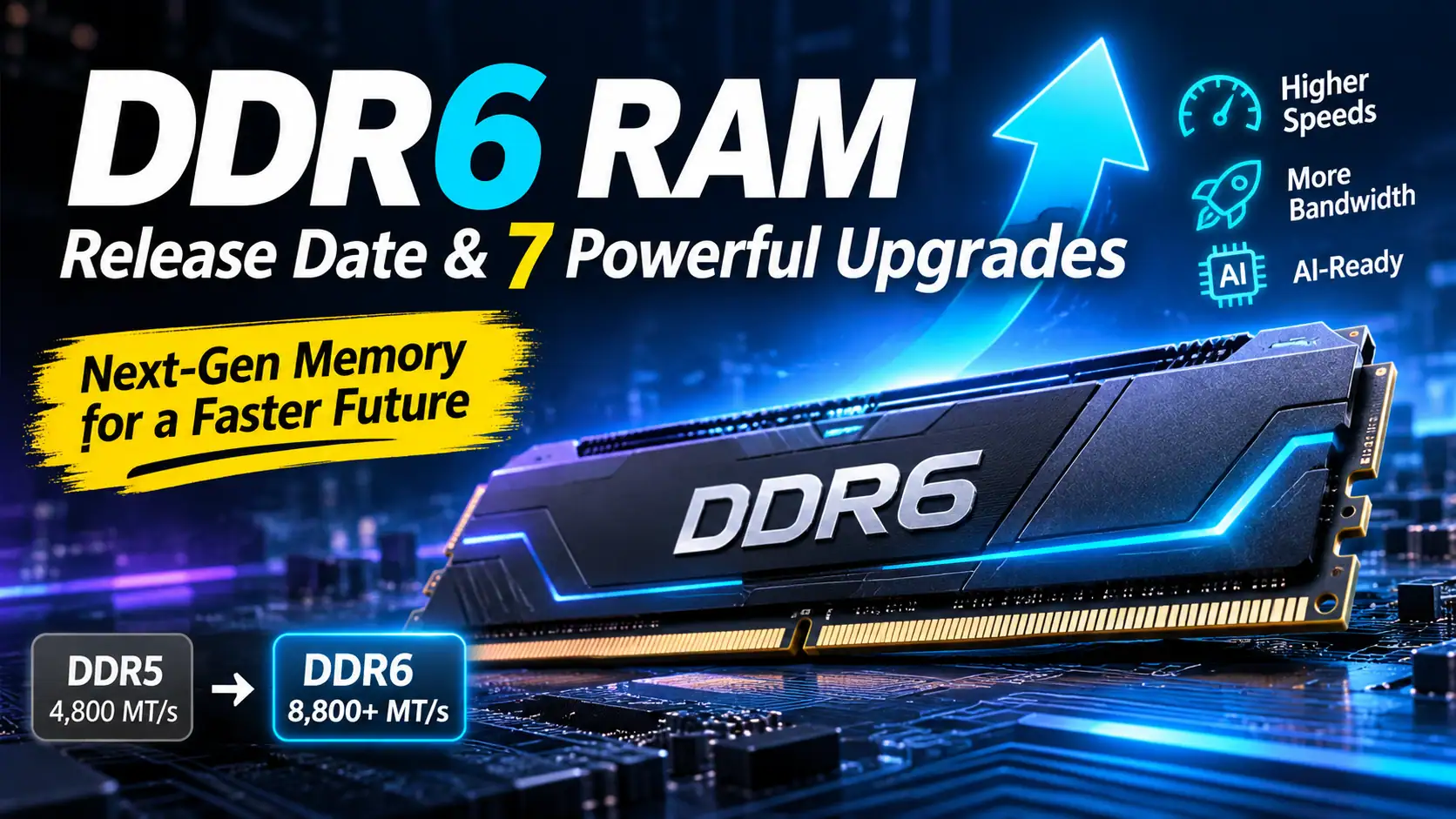
DDR6 RAM Release Date: 7 Exciting Upgrades Coming After DDR5
DDR6 RAM is the next generation of computer memory, and it could bring a major improvement in memory bandwidth, data transfer speeds and computing performance. Major manufacturers, including Samsung, SK hynix and Micron, are already working on the technology. However, DDR6 is not commercially available yet, and its final specifications have not been confirmed.
Current industry reporting points towards commercialisation around 2028–2029, although server adoption and consumer PC availability may happen at different times. Micron’s October 2026 technology roadmap also highlights DDR6 as an important part of its future AI-server memory strategy.
So, when is DDR6 RAM coming out? How much faster will it be than DDR5? And will existing motherboards support it?
Here is everything you need to know about the next generation of RAM.
1. What Is DDR6 RAM and Why Does It Matter?
DDR6 stands for Double Data Rate 6, the next generation of synchronous dynamic random-access memory (SDRAM) designed to succeed DDR5.
RAM temporarily stores the information that a computer’s processor needs to access quickly. Faster memory can improve how efficiently a system transfers data, particularly in workloads that depend heavily on memory bandwidth.
DDR5 already supports modern gaming computers, workstations and data centres. However, the growing demand for artificial intelligence, high-performance computing and advanced server infrastructure is creating new requirements for memory technology.
This is where DDR6 becomes important.
Unlike a simple speed upgrade, DDR6 is expected to introduce architectural improvements that could increase bandwidth and support more demanding computing workloads.
Its development is particularly important for:
AI servers running large language models.
Data centres handling enormous amounts of information.
High-performance computing systems.
Professional workstations and future PC platforms.
Memory-intensive applications requiring faster data movement.
The biggest expected advantage of DDR6 is its potential to deliver more than twice the bandwidth of DDR5.
2. DDR6 RAM Release Date: When Is It Coming Out?
The expected DDR6 RAM release date is one of the biggest questions among PC enthusiasts.
As of November 2026, DDR6 desktop and server memory modules are not commercially available. Major manufacturers are developing the technology, but there is no confirmed retail launch date.
According to a May 2026 report from TrendForce, industry estimates suggest that DDR6 commercialisation could begin around 2028–2029.
However, different stages of availability matter. Server manufacturers could adopt DDR6 before ordinary desktop computer users can purchase compatible memory kits.
Expected DDR6 development timeline
| Year | Expected development |
|---|---|
| 2026 | Early development, prototype work and specification refinement |
| 2027 | Further validation and next-generation DRAM manufacturing progress |
| 2028 | Potential early commercialisation |
| 2029 | Potential wider adoption across compatible platforms |
These dates are industry expectations, not confirmed product launch announcements.
What did Micron reveal in October 2026?
On October 23, 2026, TechSpot reported on Micron’s next-generation memory roadmap.
The company outlined its upcoming 1-delta DRAM manufacturing node, which is expected to support next-generation memory standards, including DDR6 and LPDDR6.
Micron expects its 1-delta node to enter volume production in the second half of 2027.
However, this does not mean DDR6 memory modules will launch in 2027. The manufacturing milestone and the commercial release of DDR6 are separate events.
You can follow Micron’s official technology announcements for future updates.
3. DDR6 vs DDR5: What Are the Biggest Differences?
The most interesting part of the next memory generation is its expected performance improvement.
DDR6 is being developed to deliver substantially higher data transfer speeds and a different memory architecture.
Here is how the two generations compare based on currently reported targets.
| Specification | DDR5 | DDR6 (expected) |
|---|---|---|
| Memory generation | Current generation | Next generation |
| Initial data rate | 4,800 MT/s | Around 8,800 MT/s |
| Potential data rate | Up to 8,400 MT/s standard ceiling | Up to 17,600 MT/s |
| Sub-channel design | 2 × 32-bit | 4 × 24-bit |
| Memory bandwidth | Lower | Potentially more than 2× DDR5 |
| Compatibility | Existing DDR5 platforms | New compatible platforms required |
| Availability | Commercially available | Under development |
Note: DDR6 figures are reported development targets, not final confirmed specifications. DDR5’s standard data-rate ceiling is also not the same as the maximum speed of every commercially available overclocked kit.
The proposed DDR6 architecture uses four 24-bit sub-channels, compared with DDR5’s two 32-bit sub-channels.
This design is intended to improve parallel data handling and increase available bandwidth.
However, higher theoretical bandwidth does not automatically mean every application will become twice as fast. Real-world performance will depend on the processor, memory controller, workload and complete system design.
4. Seven Expected Upgrades That Could Make DDR6 Important
DDR6 is not just about increasing the numbers on a RAM specification sheet. Its expected improvements could influence several areas of computing.
1. More than Double the Memory Bandwidth
One of DDR6’s biggest expected advantages is higher memory bandwidth.
Reported targets suggest that the technology could eventually offer more than twice the bandwidth of DDR5.
This could benefit workloads that continuously move large amounts of data between the processor and memory.
AI computing, scientific applications and high-performance servers are among the areas that could benefit most.
2. Higher Data Transfer Speeds
DDR6 is expected to start around 8,800 MT/s, with a longer-term target of approximately 17,600 MT/s.
For comparison, DDR5 starts at 4,800 MT/s under the standard specification.
Higher transfer rates could help compatible systems process memory-intensive workloads more efficiently.
However, actual performance will depend on the complete platform rather than memory speed alone.
3. A New Four-Channel Sub-Channel Architecture
DDR5 uses two 32-bit sub-channels per module, while DDR6 is expected to use four 24-bit sub-channels.
This architectural change could improve parallel memory access and data handling.
It also introduces engineering challenges, particularly around signal integrity and high-speed memory communication.
4. Better Support for AI Data Centres
Artificial intelligence requires significant memory capacity and bandwidth.
AI servers must continuously transfer information between processors, accelerators and memory systems.
Micron has specifically positioned its DDR6 development around high-reliability server memory and AI data-centre requirements.
This makes enterprise computing one of the most important potential markets for DDR6.
5. Support for More Demanding Computing Workloads
Future workstations and server platforms will need to handle increasingly complex applications.
Higher memory bandwidth could benefit:
Large-scale data processing.
Scientific simulations.
Professional computing workloads.
Local AI inference.
Advanced server applications.
These are potential benefits, not guaranteed performance improvements for every application.
6. New Memory Platform Designs
Higher data rates make memory-module engineering more challenging.
CAMM2 has attracted attention as a possible form factor for future high-speed memory platforms, particularly in compact systems.
However, the exact DDR6 module formats and platform implementations have not been finalised.
It would be premature to claim that every DDR6 computer will use CAMM2.
7. A Stronger Foundation for Future Computing
DDR6 is being developed during a period of rapid growth in artificial intelligence, cloud computing and high-performance processors.
Its higher bandwidth targets could help future systems manage larger datasets and more demanding workloads.
However, DDR6 will work alongside other memory technologies, including HBM, rather than replacing every type of computer memory.
5. Why Are Samsung, SK hynix and Micron Developing DDR6?
Three major memory manufacturers are central to DDR6 development.
Samsung
Samsung is one of the world’s leading DRAM manufacturers. It is involved in next-generation memory development and is among the companies working towards DDR6.
SK hynix
SK hynix is another major memory manufacturer with a strong position in DRAM and high-bandwidth memory. Its next-generation memory research is important for future server and computing platforms.
Micron
Micron is an American semiconductor company that produces DRAM, NAND and other memory products.
Its October 2026 roadmap is particularly relevant because it specifically identifies DDR6 as part of its next-generation memory direction for AI infrastructure.
These companies are working within an industry-wide transition. However, no manufacturer has announced a confirmed consumer DDR6 retail launch date.
6. Will DDR6 RAM Work on Existing DDR5 Motherboards?
No. DDR6 is not expected to be backward-compatible with DDR5 motherboards.
Each DDR memory generation introduces changes to its electrical interface and physical design.
That means a DDR6 memory module cannot simply be installed into an existing DDR5 motherboard.
A compatible DDR6 system will require:
A motherboard designed for DDR6.
A processor with a compatible DDR6 memory controller.
Supported memory modules.
Compatible firmware and platform validation.
This is important for anyone planning to upgrade their desktop PC.
Even if DDR6 becomes available in the coming years, existing DDR5 systems will not automatically support it.
7. DDR6 vs LPDDR6: Are They the Same?
No. DDR6 and LPDDR6 belong to related memory generations, but they serve different purposes.
DDR6 is the next-generation standard for conventional system memory, particularly desktop and server platforms.
LPDDR6 stands for Low Power Double Data Rate 6. It is designed for devices where power efficiency and compact memory integration are important.
These include:
Smartphones.
Thin and lightweight laptops.
Tablets.
Embedded computing devices.
Selected AI-enabled systems.
LPDDR6 is already a published JEDEC standard, unlike the still-developing mainstream DDR6 specification.
It is important not to confuse LPDDR6 with desktop DDR6 or GDDR6 graphics memory.
8. Should You Wait for DDR6 or Buy DDR5?
For most people planning to purchase a computer today, waiting for DDR6 is not necessary.
DDR5 is already available, supported by modern processors and motherboards, and suitable for gaming, productivity and everyday computing.
Waiting for DDR6 could mean delaying a computer upgrade for years without a guaranteed launch date or affordable first-generation products.
Here is a simple comparison:
| Your situation | Recommendation |
|---|---|
| Building a PC today | Choose a suitable DDR5 platform |
| Buying a gaming computer | DDR5 is a practical option |
| Planning a server upgrade | Monitor DDR6 platform announcements |
| Interested in future technology | Follow DDR6 development |
| Already using DDR5 | No need to upgrade just because DDR6 is coming |
Early DDR6 products may also carry premium prices. Their actual cost will depend on manufacturing capacity, demand and compatible platform availability.
Our recommendation: Buy DDR5 when you need a computer now. Consider DDR6 when compatible hardware, independent benchmarks and reasonable prices become available.
9. Frequently Asked Questions About DDR6 RAM
When will DDR6 RAM be released?
Industry reporting suggests commercialisation could begin around 2028–2029. However, no official consumer launch date has been confirmed.
Is DDR6 RAM available in 2026?
No. Mainstream DDR6 desktop and server memory modules are not commercially available as of November 2026.
How fast will DDR6 RAM be?
Reported development targets suggest initial speeds around 8,800 MT/s, potentially reaching 17,600 MT/s. These figures are not final specifications.
Will DDR6 be twice as fast as DDR5?
DDR6 is expected to deliver more than twice DDR5’s bandwidth. However, this does not mean every computer application will run twice as fast.
Will DDR6 work with DDR5 motherboards?
No. DDR6 will require compatible motherboards and processors with supported memory controllers.
Is DDR6 better for gaming?
DDR6 could offer higher memory bandwidth, but gaming performance also depends heavily on the CPU, GPU, game engine and memory latency. There are no independent DDR6 gaming benchmarks yet.
What is the difference between DDR6 and GDDR6?
DDR6 is designed for system memory, while GDDR6 is graphics memory commonly used in graphics cards. They are different memory standards.
Is LPDDR6 already available?
LPDDR6 became a published memory standard in July 2025. It is designed for low-power devices and is different from conventional DDR6 desktop memory.
Final Verdict: Is DDR6 Worth Waiting For?
DDR6 could become an important development in computer memory, especially as artificial intelligence, data centres and high-performance computing continue to grow.
Its expected improvements in bandwidth, transfer speeds and memory architecture could provide a stronger foundation for future computing platforms.
However, the technology is still developing. Final specifications, consumer launch dates, prices and compatible processors remain unconfirmed.
For now, DDR5 remains the practical choice for people building or upgrading computers.
The real DDR6 story is not just about faster RAM. It is about preparing the next generation of computing for increasingly demanding workloads.