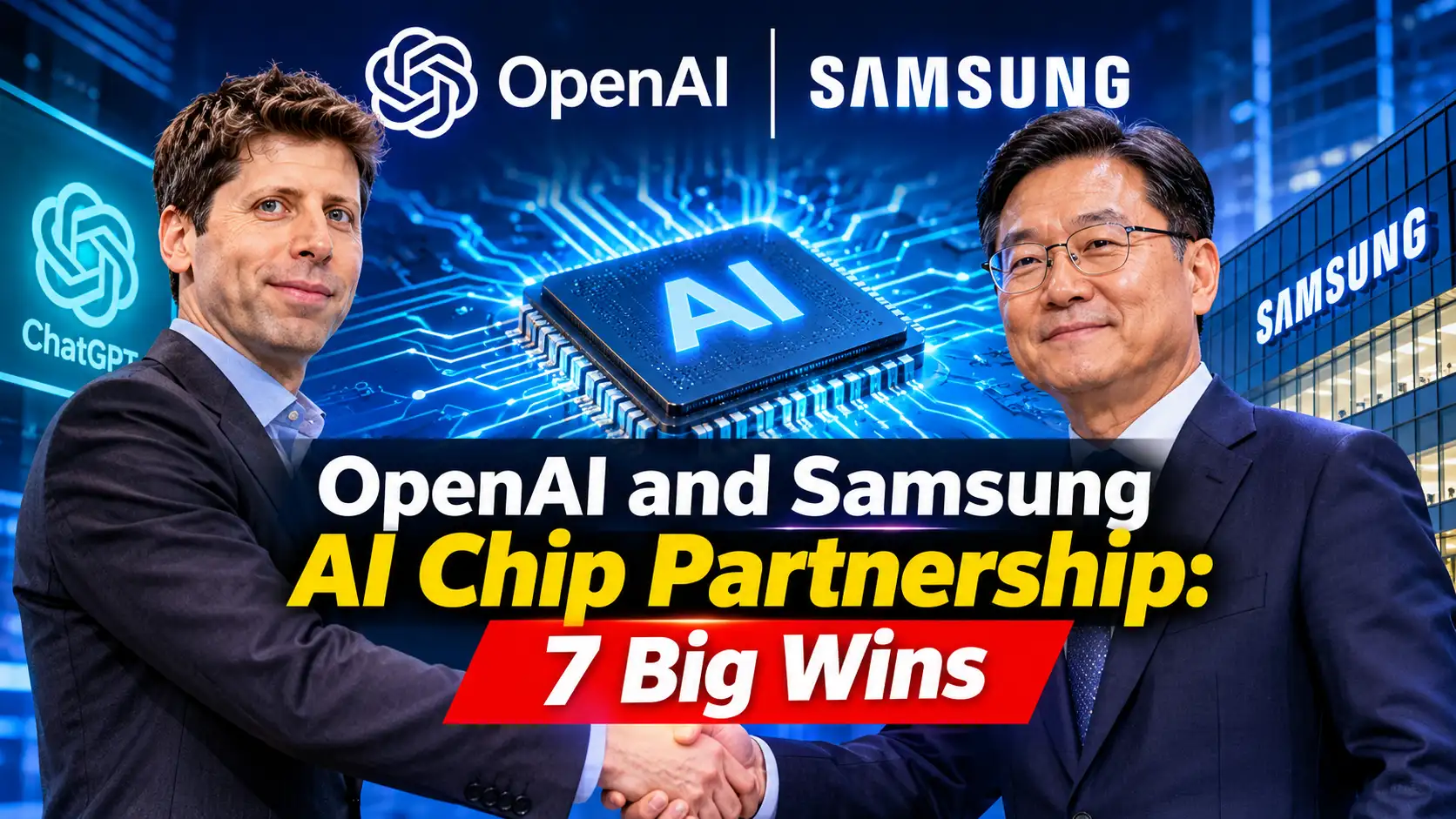
OpenAI and Samsung AI Chip Partnership: 7 Powerful Developments
Artificial intelligence is increasing the demand for powerful processors, advanced memory and large-scale data centres. As AI companies expand their infrastructure, semiconductor manufacturers are becoming more important than ever.
The OpenAI and Samsung AI chip partnership is an important development in this changing technology landscape. OpenAI needs advanced computing infrastructure to support its AI models, while Samsung has extensive experience in semiconductor manufacturing, memory technology and data-centre infrastructure.
On October 31, 2026, OpenAI CEO Sam Altman met Samsung executives in South Korea. The meeting attracted attention because of the companies’ existing cooperation and growing demand for AI hardware.
However, there is an important distinction: Samsung and OpenAI already have a strategic partnership, but they have not publicly confirmed a new standalone agreement for Samsung to manufacture OpenAI’s custom AI processors.
Here are seven important developments explaining the partnership, the technology involved and what could happen next.
1. Why Are OpenAI and Samsung Working Together?
OpenAI develops artificial intelligence systems, including ChatGPT, that require enormous computing resources. Running these systems involves specialised processors, high-speed memory and powerful data centres.
Samsung is one of the world’s major semiconductor manufacturers. Its expertise includes DRAM, high-bandwidth memory (HBM), semiconductor manufacturing and advanced packaging.
These capabilities make Samsung an important potential infrastructure partner for OpenAI.
In October 2025, Samsung and OpenAI announced a strategic partnership through a Letter of Intent (LOI). The agreement focused on supporting OpenAI’s Stargate initiative and expanding AI infrastructure.
The partnership involves several Samsung businesses:
Samsung Electronics: Advanced memory and semiconductor technology.
Samsung SDS: AI data centres and enterprise AI services.
Samsung C&T: Data-centre infrastructure development.
Samsung Heavy Industries: Potential floating data-centre development.
Samsung also identified itself as a strategic memory partner for OpenAI’s Stargate project.
This cooperation is not limited to producing computer chips. It covers several parts of the infrastructure needed to develop and operate advanced AI systems.
Source: Samsung’s official announcement, October 6, 2025.
2. Samsung's HBM Memory Could Be Important for OpenAI
One of the most important technologies in the OpenAI and Samsung partnership is High-Bandwidth Memory, commonly called HBM.
HBM is a specialised type of memory designed to transfer large amounts of data between processors and memory at high speeds.
AI accelerators need fast access to large amounts of data when training and running artificial intelligence models. Without sufficient memory bandwidth, processors may spend valuable time waiting for data.
Samsung manufactures advanced memory technologies that can support these demanding workloads.
What makes HBM important for AI?
There are three major reasons:
Higher memory bandwidth: HBM transfers data faster than many conventional memory solutions.
Efficient processor communication: It helps AI accelerators access the information they need.
Large-scale AI computing: Advanced memory is important for the servers used to train and operate modern AI models.
Samsung’s October 2025 announcement projected that OpenAI’s memory requirements could reach up to 900,000 DRAM wafer starts per month.
This figure represents a projected requirement, not a confirmed monthly delivery commitment from Samsung alone.
The growing demand for HBM shows why memory manufacturers are becoming increasingly important to the AI industry.
3. OpenAI Is Developing Its Own Custom AI Chips
Another important development is OpenAI’s work on custom AI processors.
Most AI systems depend on specialised hardware to perform complex calculations. Companies increasingly explore custom processors because they can design hardware around their particular computing requirements.
According to a Reuters report published on September 9, 2026, OpenAI was developing custom AI chips with Broadcom.
The report identified a processor called Jalapeno and described its intended use for AI inference.
AI inference is the process of using a trained AI model to generate responses, predictions or other outputs.
The distinction between AI training and inference is important:
AI training: Teaching an AI model using large datasets.
AI inference: Using an already-trained model to answer questions and perform tasks.
The Reuters report identified Taiwan Semiconductor Manufacturing Company (TSMC) as the manufacturer of the custom processor.
Samsung’s involvement in this broader semiconductor story should not be confused with manufacturing this particular processor.
OpenAI has not publicly confirmed a new Samsung agreement to manufacture its custom AI chips.
4. What Happened During Sam Altman's Samsung Meeting?
On October 31, 2026, Sam Altman visited Samsung’s Human Resources Development Center in Yongin, South Korea.
The meeting attracted attention from the technology industry because Samsung is an important player in semiconductor manufacturing and AI infrastructure.
Reports published on November 2 described several details:
Around 50 Samsung affiliate presidents attended the meeting.
OpenAI hardware vice president Richard Ho accompanied Sam Altman.
Discussions covered artificial intelligence and future business cooperation.
Altman also met SK Group chairman Chey Tae-won.
AI infrastructure and advanced memory were important areas of industry interest.
The meetings demonstrate continued high-level engagement between OpenAI and major South Korean technology companies.
However, neither company publicly confirmed that the October 31 meeting resulted in a new chip manufacturing contract or a specific investment agreement.
This distinction matters because discussions between executives do not automatically mean a commercial agreement has been signed.
5. How Does the OpenAI Stargate Project Fit Into the Partnership?
OpenAI’s Stargate project is another major reason why semiconductor and infrastructure companies are interested in working with the company.
Stargate is an initiative focused on developing large-scale AI infrastructure.
Building advanced AI infrastructure requires more than powerful processors. It also requires:
High-performance memory.
Servers and networking equipment.
Large data-centre facilities.
Electricity and cooling systems.
Advanced semiconductor packaging.
Reliable infrastructure for operating AI models.
Samsung’s October 2025 partnership announcement connected several of its businesses to these requirements.
Samsung Electronics contributes semiconductor and memory expertise, while other Samsung businesses can support data-centre services and infrastructure.
The broader objective is to help build the physical infrastructure required to support increasingly powerful AI systems.
The partnership demonstrates how AI development depends on cooperation between software companies, chip manufacturers, construction businesses and infrastructure providers.
6. Could Samsung Become More Important in the AI Chip Industry?
Samsung already has a significant position in the global semiconductor industry.
Its memory manufacturing capabilities make it an important company in the AI hardware supply chain.
However, competition in the AI semiconductor market is intense.
Companies such as NVIDIA, AMD, Broadcom, SK hynix, Intel and TSMC operate in different parts of the semiconductor ecosystem.
Their roles are not identical.
For example:
NVIDIA develops GPUs and AI computing platforms.
AMD develops processors and AI accelerators.
Broadcom develops custom semiconductor solutions.
TSMC manufactures advanced chips for customers.
SK hynix and Samsung manufacture advanced memory products.
Samsung’s potential advantage comes from its broad semiconductor capabilities, particularly memory technology and manufacturing.
If demand for AI computing continues to increase, companies that can provide reliable, high-performance memory and semiconductor solutions could become even more important.
Nevertheless, the existing OpenAI partnership does not mean Samsung has replaced NVIDIA or become OpenAI’s primary AI processor supplier.
7. What Could Happen Next in the OpenAI and Samsung Partnership?
The future of the partnership will depend on AI infrastructure demand, semiconductor technology and the commercial decisions made by both companies.
Several developments are worth watching.
More demand for HBM memory
As AI models become more computationally demanding, the need for advanced memory could continue to increase.
Samsung may benefit from additional opportunities to supply memory technologies for AI infrastructure.
Greater cooperation in data centres
The existing partnership covers data-centre development and related infrastructure.
Future announcements could provide more details about how Samsung’s businesses will support OpenAI’s computing requirements.
Custom AI processor developments
OpenAI is already pursuing custom chip development with Broadcom.
Any future announcement involving Samsung and custom processor manufacturing would be an important development, but it should not be treated as confirmed until the companies officially announce it.
Stronger competition in AI hardware
The AI semiconductor market is evolving rapidly.
Samsung, SK hynix, NVIDIA, AMD, Broadcom and TSMC will continue competing and cooperating across different parts of the industry.
The next major developments could influence how AI companies obtain the memory, processors and infrastructure required to operate their systems.
OpenAI and Samsung Partnership Timeline
The following timeline highlights the most important publicly reported developments.
| Date | Development |
|---|---|
| October 1, 2025 | OpenAI announces Stargate cooperation involving Samsung and SK. |
| October 6, 2025 | Samsung announces its strategic partnership with OpenAI. |
| September 9, 2026 | Reuters reports on OpenAI’s next-generation chip cooperation discussions involving Samsung. |
| September 11, 2026 | OpenAI clarifies that no new Samsung chip-development agreement has been announced. |
| October 31, 2026 | Sam Altman meets Samsung executives in South Korea. |
| November 2, 2026 | New reports cover the latest executive meetings and AI industry cooperation. |
Frequently Asked Questions
1. Does Samsung manufacture OpenAI's custom AI chips?
There is no publicly confirmed new agreement establishing Samsung as the manufacturer of OpenAI’s custom AI processors. Reuters reported that OpenAI was developing a custom processor with Broadcom, with TSMC identified as its manufacturer.
2. What is Samsung providing to OpenAI?
Samsung’s established partnership covers advanced memory, semiconductor expertise, AI data-centre services and broader infrastructure cooperation through its business divisions.
3. What is the OpenAI and Samsung partnership?
It is a strategic collaboration announced in October 2025 to support AI infrastructure development, including the Stargate initiative and advanced memory requirements.
4. What is HBM memory?
High-Bandwidth Memory (HBM) is a specialised memory technology designed to transfer large amounts of data quickly. It is particularly useful in AI accelerators and high-performance computing systems.
5. What happened during Sam Altman's October 2026 visit to Samsung?
Sam Altman met Samsung executives in Yongin, South Korea, on October 31, 2026. Reports described discussions about AI technology and future cooperation. No new standalone chip manufacturing agreement was publicly confirmed.
6. Is Samsung competing with NVIDIA?
Samsung and NVIDIA operate in different parts of the semiconductor industry. Samsung is a major memory and semiconductor manufacturer, while NVIDIA is a leading developer of GPUs and AI computing platforms. Their relationship involves both competition and industry cooperation.
7. Why does OpenAI need advanced memory?
Advanced memory helps AI processors access data quickly. Technologies such as HBM are important for improving the performance of AI computing systems and supporting large-scale AI workloads.
Final Verdict
The OpenAI and Samsung AI chip partnership highlights how important semiconductor technology has become to the future of artificial intelligence.
Samsung’s memory expertise, semiconductor manufacturing capabilities and infrastructure businesses make it a valuable partner for OpenAI’s growing AI ambitions.
The October 31, 2026 meeting between Sam Altman and Samsung executives adds another important development to their relationship. However, readers should distinguish existing cooperation and reported discussions from officially confirmed new chip manufacturing agreements.
As AI infrastructure continues to expand, Samsung’s role in memory technology and data-centre development will be worth watching.
The biggest takeaway: OpenAI needs powerful AI infrastructure, and Samsung has important technologies that can help build it. Their partnership is significant even without a newly announced custom-chip manufacturing deal.