Mistral Large 4: 7 Powerful Features of the 1T AI Model
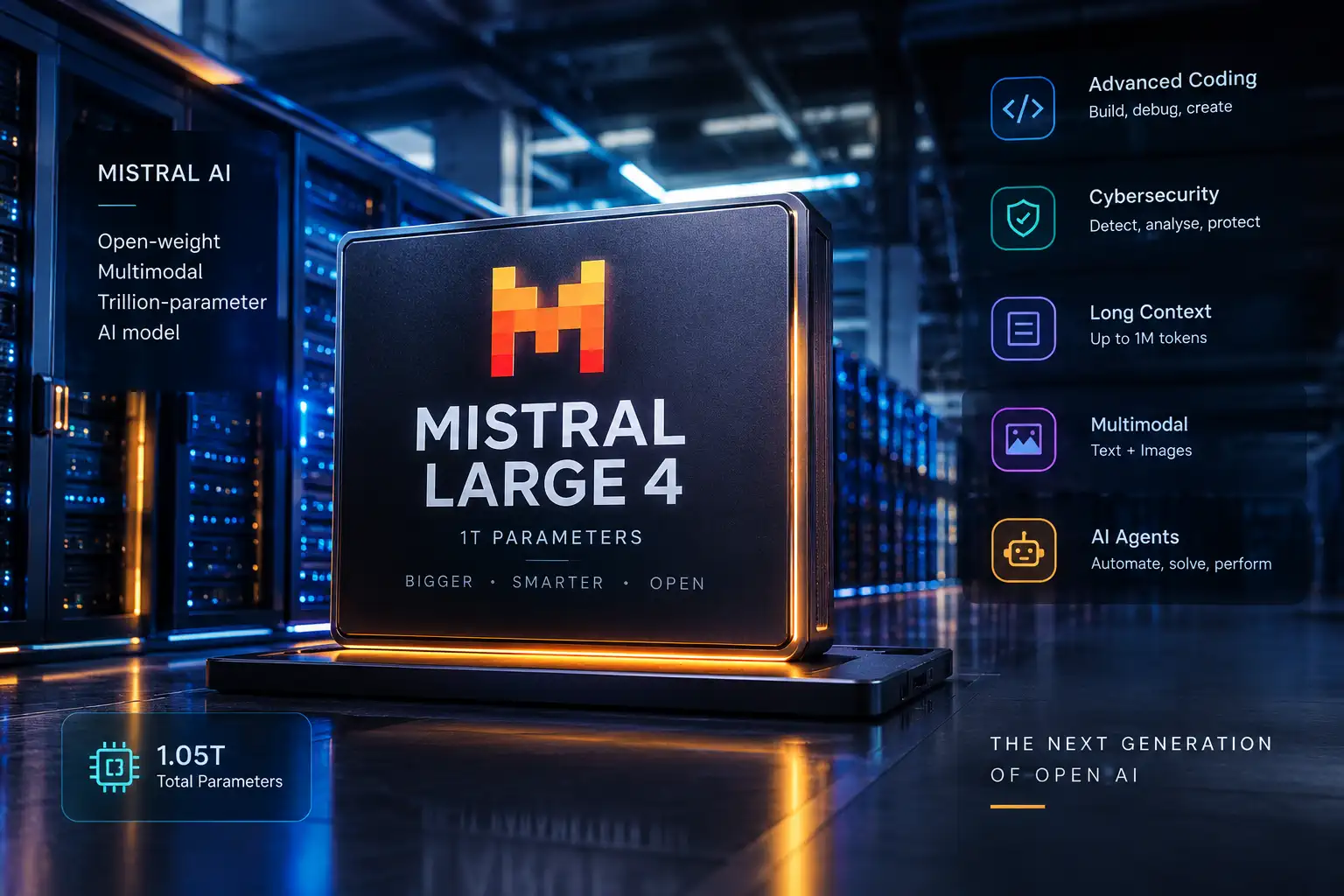
Artificial intelligence is entering a new phase as companies compete to develop more powerful, efficient and accessible AI models. One of the latest developments is Mistral Large 4, a trillion-parameter AI model released by French AI company Mistral AI. Nicknamed Le Chonk, this model combines advanced reasoning, coding capabilities, image understanding and autonomous AI workflows in one system.
What makes Mistral Large 4 particularly interesting is its open-weight approach. Instead of requiring every organisation to depend entirely on a third-party AI service, it allows developers and businesses to download and deploy the model on their own infrastructure, subject to its licence.
But how powerful is Mistral Large 4, what can it actually do, and can it compete with ChatGPT, Gemini and Claude? Here is everything you need to know about its specifications, features, pricing, performance and limitations.
What Is Mistral Large 4?
Mistral Large 4 is a large, multimodal, open-weight AI model developed by Mistral AI. It was initially introduced in public preview on October 6, 2026, and its model weights were publicly released on October 29, 2026.
The model is designed to handle demanding tasks involving software development, complex reasoning, cybersecurity, document analysis and AI-powered automation.
Unlike conventional AI systems that process only text, Mistral Large 4 can understand both text and images. It also supports tool calling, structured outputs and agent-based workflows, making it useful for developers and enterprise applications.
Its nickname, Le Chonk, reflects its enormous architecture: approximately 1.05 trillion total parameters.
However, its most important technical feature is its Mixture-of-Experts architecture, which activates only a selected portion of the model for each token rather than using every parameter simultaneously.
Mistral Large 4 Specifications: What You Need to Know
Before exploring its features, understanding the Mistral Large 4 specifications helps explain why this model is attracting attention.
| Specification | Mistral Large 4 |
|---|---|
| Developer | Mistral AI |
| Model name | Mistral Large 4 |
| Nickname | Le Chonk |
| Total parameters | Approximately 1.05 trillion |
| Active parameters | 49 billion per token; approximately 52 billion including embeddings and output layers |
| Architecture | Mixture of Experts (MoE) |
| Vision encoder | 1.6 billion parameters |
| Context window | Up to 1 million tokens |
| Input | Text and images |
| Primary capabilities | Reasoning, coding, cybersecurity and AI agents |
| Weight release | October 29, 2026 |
| Licence | Mistral Ecosystem Open-Weight License |
These specifications demonstrate that Mistral Large 4 is designed for more than ordinary conversations. Its architecture targets complex professional workloads where processing large amounts of information and completing multiple tasks are important.
7 Powerful Features of Mistral Large 4
Mistral Large 4 combines several AI capabilities that make it an interesting option for developers, researchers and businesses.
1. A Massive 1-Trillion-Parameter AI Architecture
The first major feature is its enormous parameter count. Mistral Large 4 contains approximately 1.05 trillion total parameters, making it one of the largest openly available AI models.
Parameters are numerical values that an AI model learns during training. They help determine how the model recognises patterns, processes information and generates responses.
However, having more parameters does not automatically make an AI model better. Architecture, training quality, reasoning capabilities and real-world performance also matter.
Mistral uses a Mixture-of-Experts architecture to make its large model more efficient during inference.
2. Mixture-of-Experts Architecture
One of the most interesting technologies behind Mistral Large 4 is its Mixture-of-Experts (MoE) architecture.
Instead of activating the entire neural network for every token, this architecture uses a routing mechanism to select specialised components called experts.
Mistral Large 4 contains 128 routed experts, with four selected for each token alongside one shared expert.
This means the model can benefit from a large collection of specialised parameters without activating the entire network for every operation.
For developers, this architecture offers a different balance between model capacity and computational efficiency.
However, the full model still requires substantial memory and computing resources because all its weights must be available during deployment.
3. Advanced AI Coding Capabilities
Software development is another important area where Mistral Large 4 aims to compete.
The model is designed to understand programming repositories, generate code, investigate errors and support complex software engineering workflows.
Its coding capabilities are particularly relevant for:
Understanding large software projects.
Identifying programming errors.
Generating and improving code.
Analysing terminal-based tasks.
Supporting automated software development.
Mistral also reports a 49.8% score on its Coding Agent Index evaluation for the model.
This makes Mistral Large 4 an interesting option for developers looking for AI coding assistance. However, benchmark results should not be treated as a guarantee that it will outperform every competing coding assistant in everyday development.
4. Advanced Cybersecurity Capabilities
Cybersecurity is one of the main reasons Mistral is promoting Large 4 to businesses and government organisations.
The model is designed to assist security professionals with software vulnerability analysis, investigation and patch development.
For example, security teams can use capable AI models to help:
Review source code for potential vulnerabilities.
Investigate suspicious software behaviour.
Analyse technical security reports.
Understand possible attack paths.
Develop and review software patches.
According to Mistral, cybersecurity was a major focus during the model’s development and evaluation.
However, powerful cybersecurity AI is also a dual-use technology. The same capabilities that can help defenders investigate vulnerabilities could potentially be misused. Organisations should therefore combine AI deployment with access controls, monitoring and security policies.
5. A Massive 1-Million-Token Context Window
Another important feature is the 1-million-token context window.
A context window determines how much information an AI model can process within a request or conversation.
This large context capacity can be useful when working with extensive documents, technical reports, software repositories and research materials.
For example, a developer could provide information from multiple project files and ask the model to identify connections, explain code or investigate a technical issue.
Businesses can also use long-context capabilities to analyse extensive documentation without constantly dividing information into smaller sections.
However, a larger context window does not guarantee perfect accuracy or recall. The quality of the response still depends on the information provided and the complexity of the task.
6. Multimodal Image Understanding
Mistral Large 4 is not limited to text-based conversations. It also supports image understanding through a 1.6-billion-parameter vision encoder.
This allows the model to process visual information alongside written instructions.
Potential applications include:
Understanding charts and graphs.
Analysing documents and diagrams.
Extracting information from images.
Interpreting technical drawings.
Answering questions about visual material.
This makes the model useful for applications that require both language and visual understanding.
7. Autonomous AI Agents and Enterprise Workflows
Mistral Large 4 also supports agent-oriented workflows.
An AI agent can use a model’s reasoning and tool-calling capabilities to perform multiple connected tasks instead of simply generating one response.
For example, an AI-powered business workflow could collect information, analyse documents, organise findings and prepare a report.
Its function-calling and structured-output capabilities can also help developers connect AI applications with external tools and software systems.
This is particularly useful for businesses exploring automation, internal assistants and complex digital workflows.
Mistral Large 4 Benchmark Performance
Benchmarks help developers evaluate an AI model using structured tests rather than relying entirely on marketing descriptions.
Mistral has published performance results covering coding, cybersecurity, agentic workflows and other technical tasks.
One notable reported result is its 49.8% Coding Agent Index score. The model also demonstrated improvements in terminal-based software engineering evaluations during its development.
Its cybersecurity capabilities are another major focus of the release.
However, benchmark scores can vary depending on testing methods, model versions, reasoning settings and evaluation environments. Therefore, users should compare results from equivalent independent tests before deciding which model performs best.
The most useful approach is to evaluate Mistral Large 4 using the specific tasks you intend to perform rather than relying on one overall ranking.
Is Mistral Large 4 Open Source and Free?
Mistral Large 4 is an open-weight AI model, which means its trained model weights are available for developers and organisations to download.
This provides more flexibility than relying exclusively on a hosted AI service.
Users can explore options such as:
Downloading the model weights.
Deploying the model on compatible infrastructure.
Customising the model.
Fine-tuning it for specialised applications.
Building applications around its capabilities.
However, open-weight does not necessarily mean fully open-source. The availability of model weights does not automatically provide access to the complete training dataset, training process or all underlying source code.
Mistral Large 4 uses the Mistral Ecosystem Open-Weight License. Businesses planning to offer the model as a commercial Model-as-a-Service product should review its additional commercial licensing requirements.
Therefore, it is important to check the licence before using the model in a commercial deployment.
How to Download and Use Mistral Large 4
Developers interested in trying the model can access it through Mistral’s official platform and model repository.
Here are the main options:
1. Mistral Studio: Visit the official Mistral platform to explore available models and API access.
2. Hugging Face: Visit the official Mistral Large 4 model repository to access model files, documentation and deployment information.
3. Enterprise deployment: Organisations can investigate supported deployment options through platforms such as Microsoft Foundry and compatible inference infrastructure.
Before downloading the model, check the available hardware requirements and licence conditions.
An important point for beginners: downloading the model does not mean it will run on every computer.
Mistral Large 4 Pricing: How Much Does It Cost?
Mistral Large 4 can be accessed through its hosted API, while organisations can also explore self-hosted deployment using the available weights.
According to Mistral’s published API pricing:
| API usage | Price per million tokens |
|---|---|
| Input tokens | $0.70 |
| ached input tokens | $0.07 |
| Output tokens | $2.10 |
For example, processing one million input tokens and generating one million output tokens would cost approximately $2.80 at these rates.
This calculation excludes any additional infrastructure or service costs.
Self-hosting has a different cost structure. Although downloading the weights does not require paying an API token fee, organisations still need suitable hardware, electricity, storage and deployment infrastructure.
Mistral Large 4 vs ChatGPT, Gemini and Claude
Mistral Large 4 enters a competitive market that includes ChatGPT, Google Gemini and Anthropic Claude.
Each system has different strengths, deployment options and pricing structures.
| AI platform | Main strengths |
|---|---|
| Mistral Large 4 | Open weights, coding and private deployment flexibility |
| ChatGPT | General-purpose assistance, reasoning and integrated tools |
| Google Gemini | Multimodal capabilities and Google ecosystem integration |
| Claude | Coding, document analysis and complex reasoning |
The biggest distinction is deployment flexibility. Mistral Large 4 gives developers access to downloadable model weights, while many flagship competitors are primarily accessed through hosted services.
However, this does not mean Mistral Large 4 is automatically better than ChatGPT, Gemini or Claude. Performance depends on the task, model version, configuration and evaluation method.
Disadvantages and Limitations of Mistral Large 4
Despite its impressive architecture, Mistral Large 4 has limitations that users should understand.
High hardware requirements: Its trillion-parameter architecture requires substantial memory and computing resources. Ordinary laptops are not suitable for running the full model.
Deployment complexity: Self-hosting requires technical knowledge, compatible inference software and suitable infrastructure.
API expenses: Hosted access is usage-based, so costs can increase with intensive applications.
Security considerations: Powerful cybersecurity capabilities require responsible deployment and monitoring.
Benchmark limitations: Strong performance on selected tests does not guarantee better results across every real-world application.
Licence conditions: Commercial users should review the open-weight licence carefully, especially if they intend to offer the model as a hosted service.
These limitations do not eliminate the model’s potential, but they help explain which users are most likely to benefit from it.
Frequently Asked Questions
1. What is Mistral Large 4?
Mistral Large 4 is a trillion-parameter, open-weight multimodal AI model developed by Mistral AI. It supports advanced coding, reasoning, image understanding, cybersecurity and AI-agent workflows.
2. Is Mistral Large 4 free to use?
Its model weights are publicly available, but hosted API usage is paid. Self-hosting also involves hardware and infrastructure expenses.
3. How many parameters does Mistral Large 4 have?
Mistral’s documentation lists approximately 1.05 trillion total parameters and 52 billion active parameters, including embeddings and output layers. The model card reports approximately 49 billion active parameters per token.
4. Can Mistral Large 4 run on a normal laptop?
Running the complete model on an ordinary laptop is not practical because of its enormous memory and computational requirements. It is designed for suitable server-grade infrastructure.
5. Is Mistral Large 4 better than ChatGPT?
There is no universal winner. Mistral Large 4 offers open-weight deployment flexibility, while ChatGPT provides an integrated hosted AI experience. The better option depends on your requirements.
6. What is the context window of Mistral Large 4?
Mistral lists a context window of up to one million tokens, making it suitable for applications involving extensive documents and large amounts of information.
7. Can developers download Mistral Large 4?
Yes. Developers can access its model weights through the official Hugging Face repository and review the deployment instructions and licensing conditions.
Final Verdict: Is Mistral Large 4 Worth Your Attention?
Mistral Large 4 represents an important development in the open-weight AI market. Its trillion-parameter architecture, one-million-token context window, coding capabilities and multimodal understanding make it an interesting option for developers and businesses.
Its biggest advantage is deployment flexibility. Organisations can obtain the model weights and explore running AI systems on infrastructure they control, rather than depending entirely on external AI providers.
However, its substantial hardware requirements and deployment complexity make it less suitable for ordinary users who simply want an everyday AI chatbot.
Overall, Mistral Large 4 is worth watching if you are interested in AI development, software engineering, cybersecurity or enterprise AI. Its real-world value will depend on how effectively developers and organisations use its capabilities.